Avg. daily Coalition fatality rate (nearly all Americans, and excluding Iraqis): 1.55. June was 2.1, May 2.55, and July 2005 was 1.87. Overall daily average to date is 2.28, down 0.02. Total US dead as of today: 2582.
Iraqi monthly military/police fatalities: 215. June was 132, May was 149, and July 2005 was 304. Total dead: 5117.
Iraqi monthly civilian fatalities: 1060. June was 738, May was 979, and July 2005 was 518. To-date total since March 2005: 11,495. Note that the civilian numbers may be less accurate than others, but could still be useful in determining trends.
Comments: Civilian deaths are the second-worst ever. US deaths continue a modest decrease.
Icasualties.org has published a three-year restrospective for the period ending in March, and I've read the first part of it. Summary is that Year 2 was much worse than Year 1 for Americans, while Year 3 was moderately better than Year 2. Iraqi civilian casualties seem worse in Year 3, and current data looks worse yet.
If you include American civilian deaths in Iraq, I expect the number of Americans who died in Iraq will exceed the 2,800 who died on 9/11 sometime in the next month or two. Two-three months after that, American military fatalities alone will exceed the 9/11 total.
Wednesday, August 02, 2006


Monday, July 31, 2006
Protecting against identity theft, slogging through New Year's Resolutions
As a California resident, I can tell credit bureaus to deny all access to my credit information. I did that today - it costs $30 but is a pretty good guarantee against losing money from ID theft (except from my existing credit cards, and maybe bank accounts). The only problem is that Republicans in Congress are trying to overturn this state-level protection (I wonder if they'll give me my money back), but it's here for now.
So that was one of my New Year's resolutions. Others include:
I'm not doing too badly, and I still have five months.
So that was one of my New Year's resolutions. Others include:
- Finally make an earthquake survival kit (mostly done).
- Make a living will/medical directive (done).
- Stop drinking mochas every day (much reduced).
- Install electric-only button on my Prius (done).
- Convert my Prius into an El-Cheapo plug-in hybrid (borrowed books about electricity from the library. Let's call it partly done.)
- Invest some money overseas for when the dollar crashes (done nothing).
- Don't screw up like last year and forget to do my annual investment in IRAs (nothing so far).
- Invest on expectations that stocks in companies building housing will decline (did nothing, I suspect it's too late now).
- Pay credit charges automatically from bank account so I won't keep paying late charges because I forget to pay bills (did this!).
- Renew annual resolution to learn to play harmonica (resolution renewed).
I'm not doing too badly, and I still have five months.
Sunday, July 30, 2006
More Alaska pictures
These aren't research-related, just being tourists.
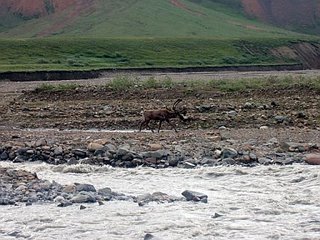
Denali Park - backcountry had no trails. We had to cross the river in front of the caribou to get to our next glacier, and several other rivers. This river was the toughest - the only one where the current was too strong to stand and fight it. Instead you "flow" downstream with it and hope you don't stumble. It's glacier runoff, a few degrees above freezing.
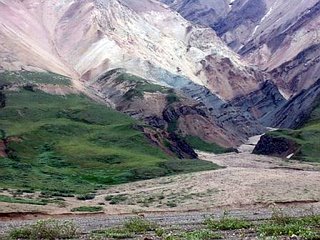
Looking down into a valley with beautiful rock layers on the far side (and a tiny caribou at the bottom). For some reason I seem to appreciate geology more as I get older. No idea why.

One of our campsites.

Riding the bus in Denali at the end of the backpacking, a wolf walked by the bus carrying a caribou leg to her pups. She's the alpha female of her pack, and has been rado-collared for study by the park biologists.

Denali Park - backcountry had no trails. We had to cross the river in front of the caribou to get to our next glacier, and several other rivers. This river was the toughest - the only one where the current was too strong to stand and fight it. Instead you "flow" downstream with it and hope you don't stumble. It's glacier runoff, a few degrees above freezing.

Looking down into a valley with beautiful rock layers on the far side (and a tiny caribou at the bottom). For some reason I seem to appreciate geology more as I get older. No idea why.
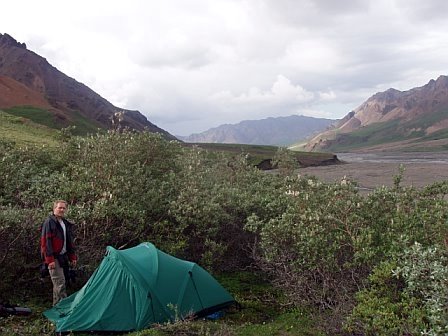
One of our campsites.
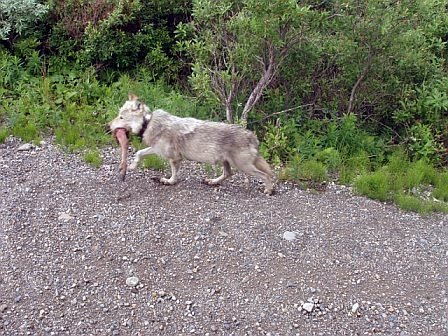
Riding the bus in Denali at the end of the backpacking, a wolf walked by the bus carrying a caribou leg to her pups. She's the alpha female of her pack, and has been rado-collared for study by the park biologists.
Thursday, July 27, 2006
Measuring glaciers
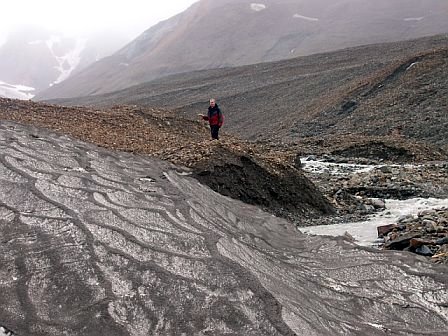
This was the "work" part of my summer vacation - walk up to the end of a glacier, turn on the GPS unit, and walk around it as much as possible (maybe a little more complicated than that, but that's the basic idea). Underneath all that rock on the left is glacier ice. Snow in the foreground added some complications for determining where the glacier edge lay, but the snowfields in mid-July were mostly gone.
 Context for the glacier - the white glacial ice is far uphill, and significant quantities of snow still further uphill, so this glacier is going to lose mass.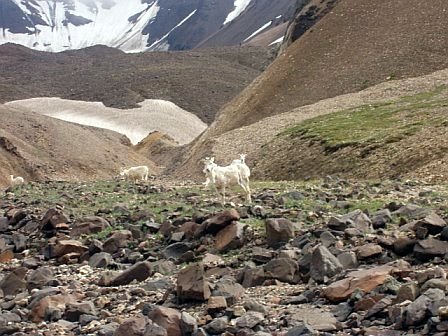
Wild Dall sheep in the foreground, rock-covered glacier in the background. I'm a tiny black speck on the horizontal rock, towards the right side, just beneath a dagger-point of snow.
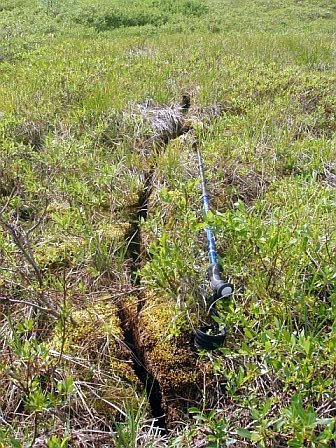 This is a weird crack in the tundra (also included to show there's a lot of greenery at Denali). I've seen the tundra torn up before by landslides, but this one looks like someone took a knife and cut it cleanly. I have no explanation for it.
Wednesday, July 26, 2006
Gyrating around No Se Nada
Kevin V. has a well thought-out post warning against technological fixes to counteract global warming, and I disagree with much of it. In particular, my policy conclusions lie on Kevin's political right, for reasons that lie on his political left.
Kevin thinks the unforeseen consequences of a poorly-understood attempt to create cooling technological forces acting on the climate could be catastrophic. No disagreement from me here, but I disagree when he adds that it's lunacy to consider doing it. My reason for disagreeing is that I think the consequences of not acting against global warming will be catastrophic, while Kevin doesn't place it at quite that level. Given our different perception of the scale of the global warming problem, I'm willing to consider risky solutions that Kevin won't.
OTOH, Kevin's point, "God forbid we should actually deal with the risk of anthropogenic climate change by dealing with the root causes" is spot on, but America won't allow the world to do it (and nobody's flocking to my trade-agreement solution for this problem). Given the lack of political will, we may have to take risks.
Finally, Kevin suggests the mostly-urban First World is more at risk from catastrophe than the agrarian Third World. I guess I'd agree if we're talking about serious fire-and-brimstone, Lovelockian catastrophe. I think more likely, still very bad scenarios will drive down the margin of comfort and safety in the First World (and kill thousands in storm events), while more-catastrophically upping the mortality level elsewhere.
Kevin thinks the unforeseen consequences of a poorly-understood attempt to create cooling technological forces acting on the climate could be catastrophic. No disagreement from me here, but I disagree when he adds that it's lunacy to consider doing it. My reason for disagreeing is that I think the consequences of not acting against global warming will be catastrophic, while Kevin doesn't place it at quite that level. Given our different perception of the scale of the global warming problem, I'm willing to consider risky solutions that Kevin won't.
OTOH, Kevin's point, "God forbid we should actually deal with the risk of anthropogenic climate change by dealing with the root causes" is spot on, but America won't allow the world to do it (and nobody's flocking to my trade-agreement solution for this problem). Given the lack of political will, we may have to take risks.
Finally, Kevin suggests the mostly-urban First World is more at risk from catastrophe than the agrarian Third World. I guess I'd agree if we're talking about serious fire-and-brimstone, Lovelockian catastrophe. I think more likely, still very bad scenarios will drive down the margin of comfort and safety in the First World (and kill thousands in storm events), while more-catastrophically upping the mortality level elsewhere.
Monday, July 24, 2006
Climate betting by Car Bobter?
Over at Stoat, an anonymous commenter claiming to be a paleoclimatologist and "of course" a skeptic of anthropogenic global warming says he/she has been regularly winning bets on 1:1 odds that global temperatures won't exceed the 1998 average (a year where temps went way up because of El Nino).
I need to give this commenter a name. I have no idea who the person is, so I'll just use the name "Car Bobter". Bobter has a good idea in the form of serial betting, which if done in the form of increasing bet amounts would increase the confidence that the losing side will pay off the winning side.
I hope I can be forgiven for thinking maybe Bobter's story about betting isn't true, but I have posted comments at Stoat asking to join Bobter's betting club (without result). I've since learned that 2006 is looking like the sixth-warmest year on record - i.e., very warm, and additional proof of climate change, but unlikely to be warmer than 1998. I'll keep my 2006 bet offer open to Bobter for just a little while longer as part of a series of bets, but for anyone else, the first bet year will be 2007.
(I do recognize that given the randomly-high temps in 1998, the bet is somewhat chancy, but with enough years in the mix then I think 1:1 odds should work out okay for me.)
I need to give this commenter a name. I have no idea who the person is, so I'll just use the name "Car Bobter". Bobter has a good idea in the form of serial betting, which if done in the form of increasing bet amounts would increase the confidence that the losing side will pay off the winning side.
I hope I can be forgiven for thinking maybe Bobter's story about betting isn't true, but I have posted comments at Stoat asking to join Bobter's betting club (without result). I've since learned that 2006 is looking like the sixth-warmest year on record - i.e., very warm, and additional proof of climate change, but unlikely to be warmer than 1998. I'll keep my 2006 bet offer open to Bobter for just a little while longer as part of a series of bets, but for anyone else, the first bet year will be 2007.
(I do recognize that given the randomly-high temps in 1998, the bet is somewhat chancy, but with enough years in the mix then I think 1:1 odds should work out okay for me.)
Friday, July 21, 2006
Beard Wars
I grew a beard over my vacation and as usual, became an object in the Beard Wars. The women who like beards (it's always women) come out and say how much they like it. After the beard comes off, the other side takes the positive-reinforcement field, and the women who didn't say anything before now say how nice a clean-shaven face looks, while the first group stays quiet. Kind of amusing.
(Of course, the first group may mean "I like the beard - that way I see less of your face," while the second may mean "glad you got the rat-nest off your chin," but they never say it that way.)
(Of course, the first group may mean "I like the beard - that way I see less of your face," while the second may mean "glad you got the rat-nest off your chin," but they never say it that way.)
Thursday, July 20, 2006
What Peiser's up to
I had wondered earlier why so many people were Googling Benny Peiser, the dishonest British academic/global warming septic. Meyrick Kirby traces it to Richard Lindzen, who also peddles some garbage of his own ("Since about 1970, many of the glaciers have stopped retreating and some are now advancing again." Got a reference for that gem, Richard? Especially a statistically meaningful reference?)
Anyway, Meyrick ferrets out more of Peiser's mistakes. What we need is a credible effort to replicate the search of peer-reviewed abstracts for the opinion on global warming. Peiser's work very much doesn't cut it.
Anyway, Meyrick ferrets out more of Peiser's mistakes. What we need is a credible effort to replicate the search of peer-reviewed abstracts for the opinion on global warming. Peiser's work very much doesn't cut it.
Tuesday, July 18, 2006
Israel and Quneitra
(Note: I'm back from vacation, will post about the glaciers soon.)
My view of Israel is generally the most left-wing stance of any of my political views besides population control - I think Israel's treatment of Palestinians is abominable and an affront to Judaism, and a cause of many of Israel's current problems. The current crisis is different though. Cross-border attacks on Israel after the country bugged out of Gaza and Lebanon are clear acts of war. Regardless of whether Israel is using the captured soldiers as an excuse, the refusal to return them gives Israel a reason to continue its actions. Israel is showing little concern for civilian life, but in practice warfare hasn't cared too much about that. It's acts are probably well within typical just war theories.
Whether they're good policy is a totally different question though. The weekend NYTimes argued this helps Hezbollah preseve its military identity as something separate from the fragile Lebanese state. Israel is unlikely to permanently occupy Lebanon again, and Hezbolloah would benefit if it does. Other than temporarily destroying Hez missile supplies, I see only a small chance of gain that would depend on whether the Lebanese believe that the Palestinian fight isn't theirs also, and that Hez stuck its nose in something not its business.
Jonathan Zasloff has a different idea - that Israel should take take a tiny slice of Syria in retribution for what its client, Hezbollah, is doing. I like innovative ideas, and this avoids the traditional civilian bloodshed. Whether it's in Israel's interest isn't clear though to me - that would depend on the countermeasures Syria has. Not military countermeasures, of course, but whether Syria is holding back Hez or other terrorist groups, and can make things even worse in retribution for losing territory.
What IS clear is that it's not in America's interest for the Quneitra option to happen. If Israel can go after the patron of the enemy that attacked it, Syria should have the same option and go after us. Syria's middling cooperation on terrorism issues could change in a far worse direction.
It's important to keep the different interests straight.
My view of Israel is generally the most left-wing stance of any of my political views besides population control - I think Israel's treatment of Palestinians is abominable and an affront to Judaism, and a cause of many of Israel's current problems. The current crisis is different though. Cross-border attacks on Israel after the country bugged out of Gaza and Lebanon are clear acts of war. Regardless of whether Israel is using the captured soldiers as an excuse, the refusal to return them gives Israel a reason to continue its actions. Israel is showing little concern for civilian life, but in practice warfare hasn't cared too much about that. It's acts are probably well within typical just war theories.
Whether they're good policy is a totally different question though. The weekend NYTimes argued this helps Hezbollah preseve its military identity as something separate from the fragile Lebanese state. Israel is unlikely to permanently occupy Lebanon again, and Hezbolloah would benefit if it does. Other than temporarily destroying Hez missile supplies, I see only a small chance of gain that would depend on whether the Lebanese believe that the Palestinian fight isn't theirs also, and that Hez stuck its nose in something not its business.
Jonathan Zasloff has a different idea - that Israel should take take a tiny slice of Syria in retribution for what its client, Hezbollah, is doing. I like innovative ideas, and this avoids the traditional civilian bloodshed. Whether it's in Israel's interest isn't clear though to me - that would depend on the countermeasures Syria has. Not military countermeasures, of course, but whether Syria is holding back Hez or other terrorist groups, and can make things even worse in retribution for losing territory.
What IS clear is that it's not in America's interest for the Quneitra option to happen. If Israel can go after the patron of the enemy that attacked it, Syria should have the same option and go after us. Syria's middling cooperation on terrorism issues could change in a far worse direction.
It's important to keep the different interests straight.
Tuesday, June 27, 2006
Hello, Alaska glaciers!
This blog will be inactive for vacation - we're off to Denali National Park and other parts of Alaska at the end of this week. We plan to do some glacier monitoring similar to what I did at Glacier National Park last fall, and then have some free time. We're open to suggested activities in Alaska if anyone has ideas over the next few days. I used to work at Denali and look forward to returning, but I don't know other areas of the state that well.
Enjoy the summer, everyone, and my next post probably won't be until after July 16th.
Enjoy the summer, everyone, and my next post probably won't be until after July 16th.
Monday, June 26, 2006
Ernst Zundel and capital punishment and 9/11 conspiracies and everyone's screwing up
Ernst Zundel, author of "The Hitler We Loved and Why," whose second wife said "By the end, I thought he was evil incarnate," is a political prisoner in Germany, currently going through a criminal trial because he denied the Holocaust. He was also deported from the US and Canada, bringing our nations into the mess.
I see a parallel to capital punishment, because like the majority of death row inmates, he doesn't deserve what's happening to him but he's also truly awful. It makes it hard to want to lift a finger to help him, especially after reading lovely quotes from his Hitler worship. But like any other type of repression, Germany's habit of imprisoning people for spreading hate has consequences. People who buy the 9/11 conspiracy theories are looking at Israeli/Jewish connections, and it's easy to tie actual repression of anti-Jewish sentiments as a way to support their theory that the truth about 9/11 is being repressed.
Anyway, time to assign blame: as for the US, we deported him for a visa overstay. I think it's possible that would've been overlooked for a non-controversial person, but I don't know how the enforcement machinery operates. I can't confirm that we screwed up, just suspect that we did. Kind of an interesting parallel to another bastard, Ward Churchill.
Canada refused asylum and deported him for potential involvement in actual hate crimes, but used secret evidence. Blame Canada on that - you couldn't (easily) get away with that in an actual criminal trial. He was also previously convicted for the violation of spreading hate on the internet - in other words, thought crime.
Germany deserves the most blame (after Zundel) because of their stupid laws. Their democracy is a crock if it can't withstand a bunch of fools telling lies 50 years after Hitler got a small taste of what he deserved.
And a special raspberry for Amnesty International - here's a stupid letter they wrote in 2003, apparently buying into the idea of a hate crime where the only "crime" was hate (note it's reproduced by a Zundel supporter, though, so some caution about what AI actually wrote). I tried to find what AI thinks about German Holocaust Denial laws in general, but didn't find anything.
UPDATE: edited for politeness.
I see a parallel to capital punishment, because like the majority of death row inmates, he doesn't deserve what's happening to him but he's also truly awful. It makes it hard to want to lift a finger to help him, especially after reading lovely quotes from his Hitler worship. But like any other type of repression, Germany's habit of imprisoning people for spreading hate has consequences. People who buy the 9/11 conspiracy theories are looking at Israeli/Jewish connections, and it's easy to tie actual repression of anti-Jewish sentiments as a way to support their theory that the truth about 9/11 is being repressed.
Anyway, time to assign blame: as for the US, we deported him for a visa overstay. I think it's possible that would've been overlooked for a non-controversial person, but I don't know how the enforcement machinery operates. I can't confirm that we screwed up, just suspect that we did. Kind of an interesting parallel to another bastard, Ward Churchill.
Canada refused asylum and deported him for potential involvement in actual hate crimes, but used secret evidence. Blame Canada on that - you couldn't (easily) get away with that in an actual criminal trial. He was also previously convicted for the violation of spreading hate on the internet - in other words, thought crime.
Germany deserves the most blame (after Zundel) because of their stupid laws. Their democracy is a crock if it can't withstand a bunch of fools telling lies 50 years after Hitler got a small taste of what he deserved.
And a special raspberry for Amnesty International - here's a stupid letter they wrote in 2003, apparently buying into the idea of a hate crime where the only "crime" was hate (note it's reproduced by a Zundel supporter, though, so some caution about what AI actually wrote). I tried to find what AI thinks about German Holocaust Denial laws in general, but didn't find anything.
UPDATE: edited for politeness.
Sunday, June 25, 2006
Some documentaries on DVD
World Trade Center: Anatomy of the Collapse: decent portrayal of what happened. I think the details of the collapse are portrayed slightly differently between this 2002 documentary and more recent analyses. Nothing really new for those of us condemned to follow the 9/11 Conspiracy stuff. Good video of how uninsulated steel structure collapses in a fire.
Bush Family Fortunes: The Best Democracy Money Can Buy: A Greg Palast documentary, I think he overplays his "discoveries" that seem familiar to me. The story is that Bushes aren't to be trusted. I agree, but it's nothing exceptional.
Uncovered: The War on Iraq: This one's a little better. While mostly old news, the interesting part was David Kay's discussion of how he went about reviewing whether WMDs were in Iraq after the war. While Kay was clearly a conservative, he was also clear in setting up an unbiased review process. Kay got the right result, while Bush handed us a disaster.
Murderball: The best of the lot, covering the game of quadraplegic wheelchair rugby, with an unvarnished human element to the documentary. I highly recommend it. If you get this DVD, you must watch the "extra" segment featuring the stars' appearance on the TV show "Jackass," where they show themselves to be male twenty-something jackasses - full of life, humor, and mind-blowing stupidity. And then the contrasting reaction seeing the Iraq war veteran amputees, none of whom look old enough to have graduated from high school.
Before Stonewall: A 1984 documentary on gay rights and culture in America prior to the 1969 Stonewall riots, it felt more like a series of anecdotes than an overview. It provided some context for a period I know nothing about, but someone else needs to give the history another try. It would be interesting to learn about gay rights in other countries during that period too.
The "Grizzly Man" documentary is well known, but I'd encourage people to also watch The Wild Parrots of Telegraph Hill for a perspective on a similar but far less harmful person who can't fit in society and anthropomorphizes his animals.
And while not a documentary at all, I can't ignore the Deadwood television series. It tries to be a cowboy western co-written by William Shakespeare and William Faulkner, and it comes close. Second season isn't quite as good as the first, but it's still one of the best shows I've ever seen. Hard to believe there's better stuff than Joss Whedon's Firefly series, but there is.
Bush Family Fortunes: The Best Democracy Money Can Buy: A Greg Palast documentary, I think he overplays his "discoveries" that seem familiar to me. The story is that Bushes aren't to be trusted. I agree, but it's nothing exceptional.
Uncovered: The War on Iraq: This one's a little better. While mostly old news, the interesting part was David Kay's discussion of how he went about reviewing whether WMDs were in Iraq after the war. While Kay was clearly a conservative, he was also clear in setting up an unbiased review process. Kay got the right result, while Bush handed us a disaster.
Murderball: The best of the lot, covering the game of quadraplegic wheelchair rugby, with an unvarnished human element to the documentary. I highly recommend it. If you get this DVD, you must watch the "extra" segment featuring the stars' appearance on the TV show "Jackass," where they show themselves to be male twenty-something jackasses - full of life, humor, and mind-blowing stupidity. And then the contrasting reaction seeing the Iraq war veteran amputees, none of whom look old enough to have graduated from high school.
Before Stonewall: A 1984 documentary on gay rights and culture in America prior to the 1969 Stonewall riots, it felt more like a series of anecdotes than an overview. It provided some context for a period I know nothing about, but someone else needs to give the history another try. It would be interesting to learn about gay rights in other countries during that period too.
The "Grizzly Man" documentary is well known, but I'd encourage people to also watch The Wild Parrots of Telegraph Hill for a perspective on a similar but far less harmful person who can't fit in society and anthropomorphizes his animals.
And while not a documentary at all, I can't ignore the Deadwood television series. It tries to be a cowboy western co-written by William Shakespeare and William Faulkner, and it comes close. Second season isn't quite as good as the first, but it's still one of the best shows I've ever seen. Hard to believe there's better stuff than Joss Whedon's Firefly series, but there is.
Thursday, June 22, 2006
Something's up with Benny Peiser
Benny Peiser is a British anthropologist who's been dishonest about some denialist work he's done on global warming.
In the last week or so, my site stats show a lot of people coming to my blog to look him up. While it gives me a public-service glow to see that someone got here after Googling Peiser, I also wonder why it's happening so much lately. I suspect he's up to no good.
In the last week or so, my site stats show a lot of people coming to my blog to look him up. While it gives me a public-service glow to see that someone got here after Googling Peiser, I also wonder why it's happening so much lately. I suspect he's up to no good.
Tuesday, June 20, 2006
Global warming cut-and-paste for charity
I have an idea that readers can use to make money for charity - if you see any blogger or even any commenter on any blog, anywhere, who denies that temperatures will be trending upwards in the next 10-20 years, just cut and paste the following italicized text into a comment:
If you don't believe that global warming is more likely than cooling over the next few decades, then you can make money for a charity of your choice. Go to here:
http://www.longbets.org/196
The bettor there believes that global warming will happen. You bet against him and both of you give a tax-deductible donation to the Long Now Foundation. When the bet pays off, all the money goes to the charity of the winner's choice. His bet offer has been sitting there unanswered for over a year. This is your chance to put your money where your mouth is, double the amount of money you'd normally give to charity, and make sure HIS money goes to whatever cause YOU think is worthy. Check it out.
---------
Of course, the bettor is me and I think I'm going to win, and I also intend to give the money to a worthwhile environmental charity. To give further incentive to readers, if your cut and paste ultimately results in a bet, I'll give $100 to the charity of your choice. I'm also going to add a hot link to this post near the top left of my blog, so the cut-and-paste will be easy to find.
(If you feel like going out and to look for trouble, click here to search blog posts on global warming.)
And in other betting news:
James Annan's bet was briefly mentioned by global warming denialist Tom Bethell on National Public Radio, in a debate with Chris Mooney. More info here. It was a good move by the denialist to bring it up first as if the betting issue has been settled, but a simple response is, "There are plenty more global warming proponents who can't find any denialists willing to take bets - why don't you take them up on the chance to relieve them of their money?"
Tim Lambert covers more denialist nonsense here by Tom Harris and Gary Sharp. I've sent them both bet offers, and we'll have to wait to see if either one surprises me with a response.
Unsurprisingly, I've heard nothing from San Francisco columnists Debra Saunders and Cinnamon Stilwell, so we can probably put them in the unwilling-to-bet category.
If you don't believe that global warming is more likely than cooling over the next few decades, then you can make money for a charity of your choice. Go to here:
http://www.longbets.org/196
The bettor there believes that global warming will happen. You bet against him and both of you give a tax-deductible donation to the Long Now Foundation. When the bet pays off, all the money goes to the charity of the winner's choice. His bet offer has been sitting there unanswered for over a year. This is your chance to put your money where your mouth is, double the amount of money you'd normally give to charity, and make sure HIS money goes to whatever cause YOU think is worthy. Check it out.
---------
Of course, the bettor is me and I think I'm going to win, and I also intend to give the money to a worthwhile environmental charity. To give further incentive to readers, if your cut and paste ultimately results in a bet, I'll give $100 to the charity of your choice. I'm also going to add a hot link to this post near the top left of my blog, so the cut-and-paste will be easy to find.
(If you feel like going out and to look for trouble, click here to search blog posts on global warming.)
And in other betting news:
James Annan's bet was briefly mentioned by global warming denialist Tom Bethell on National Public Radio, in a debate with Chris Mooney. More info here. It was a good move by the denialist to bring it up first as if the betting issue has been settled, but a simple response is, "There are plenty more global warming proponents who can't find any denialists willing to take bets - why don't you take them up on the chance to relieve them of their money?"
Tim Lambert covers more denialist nonsense here by Tom Harris and Gary Sharp. I've sent them both bet offers, and we'll have to wait to see if either one surprises me with a response.
Unsurprisingly, I've heard nothing from San Francisco columnists Debra Saunders and Cinnamon Stilwell, so we can probably put them in the unwilling-to-bet category.
Thursday, June 15, 2006
The Reasonable Libertarian and Vegetable Insurance
Following Kevin's and James' posts on the need for bicyclist/motorcyclist helmets and helmet laws, I thought I'd add what the reasonable libertarian position would be. This treads on the area where I'm closest to a doctrinaire libertarian - when it involves forcing adults to do something "for their own good." The Reasonable Libertarian seeks to maximize individual freedom while protecting societal interests, and I don't see how that gives society the right to protect competent adults from their own risk-taking.
Of course, if a motorcyclist dies, then family members are saddened, but that extreme argument really means your individual autonomy is meaningless. A much better argument is not to protect motorcyclists from themselves, but to protect society from direct, reasonable impacts of the rider's stupidity. The Reasonable Libertarian position would therefore focus on Vegetable Insurance. By law, motorcyclists must wear helmets, UNLESS they buy Vegetable Insurance, which will pay for their lifetime medical costs if they crash and turn into vegetables. A sticker would be placed prominently on the bike, and they must carry the insurance record with them when they ride.
As for bicyclists - they should wear helmets (I think James is wrong, based on nothing more scientific than my gut feeling), but adults shouldn't be legally required to wear them.
Of course, if a motorcyclist dies, then family members are saddened, but that extreme argument really means your individual autonomy is meaningless. A much better argument is not to protect motorcyclists from themselves, but to protect society from direct, reasonable impacts of the rider's stupidity. The Reasonable Libertarian position would therefore focus on Vegetable Insurance. By law, motorcyclists must wear helmets, UNLESS they buy Vegetable Insurance, which will pay for their lifetime medical costs if they crash and turn into vegetables. A sticker would be placed prominently on the bike, and they must carry the insurance record with them when they ride.
As for bicyclists - they should wear helmets (I think James is wrong, based on nothing more scientific than my gut feeling), but adults shouldn't be legally required to wear them.
Wednesday, June 14, 2006
An open letter to to Debra Saunders and Cinnamon Stilwell
Dear Ms. Saunders and Ms. Stilwell,
I see in your recent Chronicle articles criticizing Al Gore that you promote the ideas of global warming denialists and skeptics, and the more recent position to the effect of "it's just a coincidentally-natural warming, people." These ideas have no support in the scientific literature or from within the scientific consensus.
I suggest you put your money where your mouths are, something that's especially relevant when you presumably make some money from your columns advocating this stuff. Please bet me over whether global warming is happening, or over whether we're in a natural warming cycle. I've asked Ms. Saunders once before to bet me, and heard nothing; seeing as she continues to support these opinions, maybe she will be willing to bet. I hope that Ms. Stilwell will also be interested.
Ms. Saunders, you cite Bill Gray and Richard Lindzen for support, both of whom are unwilling to bet over global warming. You also cite noted Creationist Roy Spencer, whose discredited work on satellite temperature readings might give some pause, but apparently doesn't. Ms. Stilwell, you cite the "it's just natural" argument prepared in advance by people highly unlikely to admit that their lifestyles could be problematic for others. Curiously, not even fringe climatologists seem to support that viewpoint.
There are enormous consequences to what we do about global warming. I'll even admit there are consequences to spending money on stopping a dangerous warming that wouldn't actually happen, although it's less harmful than the consequences of your advice being wrong. Given the consequences, I'm willing to back up my position with money, and I hope you would do the same.
I expect one reaction would be to say that you haven't claimed Al Gore is wrong, but just that he hasn't proved his position. My response is that my bet offers are very generous to the skeptic position, so only someone who gives a significant chance to human-caused warming would reject them. In other words, if you reject action on global warming and also reject my bets, then you are applying the precautionary principle to your money, but not to other people's lives.
I could call this a "put up or shut up" email, but I actually prefer to give the issue an immediacy that will people more thoughtful about rejecting the scientific consensus. If not, then I hope to make some money.
My bet offers are here:
http://backseatdriving.blogspot.com/2005_05_01_backseatdriving_archive.html#111700433898143899
and on natural warming:
http://backseatdriving.blogspot.com/2005/10/believers-in-natural-global-warming.html
I hope to hear from you both.
Sincerely,
Brian Schmidt
I see in your recent Chronicle articles criticizing Al Gore that you promote the ideas of global warming denialists and skeptics, and the more recent position to the effect of "it's just a coincidentally-natural warming, people." These ideas have no support in the scientific literature or from within the scientific consensus.
I suggest you put your money where your mouths are, something that's especially relevant when you presumably make some money from your columns advocating this stuff. Please bet me over whether global warming is happening, or over whether we're in a natural warming cycle. I've asked Ms. Saunders once before to bet me, and heard nothing; seeing as she continues to support these opinions, maybe she will be willing to bet. I hope that Ms. Stilwell will also be interested.
Ms. Saunders, you cite Bill Gray and Richard Lindzen for support, both of whom are unwilling to bet over global warming. You also cite noted Creationist Roy Spencer, whose discredited work on satellite temperature readings might give some pause, but apparently doesn't. Ms. Stilwell, you cite the "it's just natural" argument prepared in advance by people highly unlikely to admit that their lifestyles could be problematic for others. Curiously, not even fringe climatologists seem to support that viewpoint.
There are enormous consequences to what we do about global warming. I'll even admit there are consequences to spending money on stopping a dangerous warming that wouldn't actually happen, although it's less harmful than the consequences of your advice being wrong. Given the consequences, I'm willing to back up my position with money, and I hope you would do the same.
I expect one reaction would be to say that you haven't claimed Al Gore is wrong, but just that he hasn't proved his position. My response is that my bet offers are very generous to the skeptic position, so only someone who gives a significant chance to human-caused warming would reject them. In other words, if you reject action on global warming and also reject my bets, then you are applying the precautionary principle to your money, but not to other people's lives.
I could call this a "put up or shut up" email, but I actually prefer to give the issue an immediacy that will people more thoughtful about rejecting the scientific consensus. If not, then I hope to make some money.
My bet offers are here:
http://backseatdriving.blogspot.com/2005_05_01_backseatdriving_archive.html#111700433898143899
and on natural warming:
http://backseatdriving.blogspot.com/2005/10/believers-in-natural-global-warming.html
I hope to hear from you both.
Sincerely,
Brian Schmidt
Sunday, June 11, 2006
It's not just bloggers - an audience reacts to CEI ad on carbon dioxide

The above is a 20-second audio clip from NPR's "Wait Wait, Don't Tell Me" (for full length, click on "Wait Wait", and then click on Panel Round Two). The website gives a much much better sound quality, I was just experimenting here.
Seems the audience has the same reaction as the blogosphere.
More fun wikipedia edits!
I could blame it on rash encouragement, but I was planning to do it anyway: I updated Patrick Michaels' and "global warming skeptics'" entries on wikipedia to include information on betting over global warming. Since Michaels, Gray, and Lindzen either actually invited or all-but-invited bets, I'm glad to have them and the catch-all site updated, but I'm not in as much as a hurry to get the countless other denialists who have turned down offers. Some day, maybe.
Friday, June 09, 2006
Thoughts of a Jury Foreman
(Guest posting by Dad.)
As a practicing attorney, I had never been allowed the viewpoint of the jury box, until now. Recently I was sworn in as jury foreman of a jury of 6 in a misdemeanor case at a Florida county courthouse. It was very illuminating, but also frustrating. There are many things that could be done to drastically improve our justice system.
The first is for the district attorney's office to persuade the victim who brings the case on a statement of information, to use alternative methods besides the criminal courthouse. Our case involved a domestic dispute, and it became clear to us that both the victim and the accused needed to have at least a year of counseling. Indeed, that might have been the sentencing if we could have been justified in finding the accused guilty, but we could not - it was one of those cases where we thought the accused probably was not innocent, but because of the state's ineptitude, we had to bring a verdict of not guilty. And of course, we were not able nor even tried to bring up the counseling suggestion at any point in the proceeding. (Did the judge do it privately out of the hearing of the jury? Is that something a misdemeanor judge would even DO?)
Which brings me to the second thought. We the jury wanted two things during our deliberation: we wanted a review of some of the evidence from the court transcript (evidence we had just heard that day), plus we wanted more instruction from the judge on a key issue. When we submitted those 2 questions, the judge called us out to simply inform us that as to a) the evidence, we had to rely on our best recollection. As to b) the instructions, we already had clear and sufficient instructions. Thank you, judge, very much. If we had thought what we had was sufficient, we would not have posed the questions, for crying out loud.
The third thing is something that I expect most juries complain about - there were questions that should have been asked by the appropriate attorney, but were not, and WE WANTED TO ASK THEM. But of course, that is not our time-honored practice. Heaven forbid that we should make such drastic changes in our hallowed justice system, even in the interest of bringing more justice. But if the courts ever do become more open-minded, it might be possible to allow juries to pose questions by funneling them through the judge.
Of you who are attorneys, if you think it appropriate, feel free to forward my message to any attorney or judge friends you might think would be interested. Also, if any of you have reasons why my ideas are unsound or impractical, I would appreciate hearing them.
Dana Schmidt
As a practicing attorney, I had never been allowed the viewpoint of the jury box, until now. Recently I was sworn in as jury foreman of a jury of 6 in a misdemeanor case at a Florida county courthouse. It was very illuminating, but also frustrating. There are many things that could be done to drastically improve our justice system.
The first is for the district attorney's office to persuade the victim who brings the case on a statement of information, to use alternative methods besides the criminal courthouse. Our case involved a domestic dispute, and it became clear to us that both the victim and the accused needed to have at least a year of counseling. Indeed, that might have been the sentencing if we could have been justified in finding the accused guilty, but we could not - it was one of those cases where we thought the accused probably was not innocent, but because of the state's ineptitude, we had to bring a verdict of not guilty. And of course, we were not able nor even tried to bring up the counseling suggestion at any point in the proceeding. (Did the judge do it privately out of the hearing of the jury? Is that something a misdemeanor judge would even DO?)
Which brings me to the second thought. We the jury wanted two things during our deliberation: we wanted a review of some of the evidence from the court transcript (evidence we had just heard that day), plus we wanted more instruction from the judge on a key issue. When we submitted those 2 questions, the judge called us out to simply inform us that as to a) the evidence, we had to rely on our best recollection. As to b) the instructions, we already had clear and sufficient instructions. Thank you, judge, very much. If we had thought what we had was sufficient, we would not have posed the questions, for crying out loud.
The third thing is something that I expect most juries complain about - there were questions that should have been asked by the appropriate attorney, but were not, and WE WANTED TO ASK THEM. But of course, that is not our time-honored practice. Heaven forbid that we should make such drastic changes in our hallowed justice system, even in the interest of bringing more justice. But if the courts ever do become more open-minded, it might be possible to allow juries to pose questions by funneling them through the judge.
Of you who are attorneys, if you think it appropriate, feel free to forward my message to any attorney or judge friends you might think would be interested. Also, if any of you have reasons why my ideas are unsound or impractical, I would appreciate hearing them.
Dana Schmidt
Monday, June 05, 2006
May 2006 Iraq casualties
Avg. daily military fatality rate (nearly all of them Americans): 2.55. April was 2.73, March was 1.06, and May 2005 was 2.84. Overall average to date is 2.3. Total US dead as of today: 2476.
Iraqi monthly military/police fatalities: 149. April was 201, March was 193, and May 2005 was 259. Total dead: 4751.
Iraqi monthly civilian fatalities: 979. April was 809, March was 901, and May 2005 was 572. Total since March 2005: 9817. Note that the civilian numbers may be less accurate than others, but could still be useful in determining trends.
Comments: There's a bad trend in recent months for civilian deaths, while US and Iraqi military deaths continue at a typical rate. Not sure what to make of this.
Iraqi monthly military/police fatalities: 149. April was 201, March was 193, and May 2005 was 259. Total dead: 4751.
Iraqi monthly civilian fatalities: 979. April was 809, March was 901, and May 2005 was 572. Total since March 2005: 9817. Note that the civilian numbers may be less accurate than others, but could still be useful in determining trends.
Comments: There's a bad trend in recent months for civilian deaths, while US and Iraqi military deaths continue at a typical rate. Not sure what to make of this.
Sunday, June 04, 2006
Inconvenient Truth of Volokh Correction #12
I watched Al Gore's movie on Friday - like everyone says, it's very good. My companion who's not a global warming nerd liked the two-thirds of the movie about warming the most, while I actually preferred the one-third that was biographical. AGW nerds aren't going to learn a whole lot, but a few things were new to me, and it was the best PowerPoint presentation I've ever seen. Real Climate and Roger Ebert have the best reviews.
Which brings me to Volokh Conspirator Dave Kopel, who argues elsewhere that the history of mainstream media alarmism over climate change should be used to discount media portrayals of global warming. Kopel would be surprised if he ever bothers to watch Gore's movie to learn that Gore would agree somewhat - the media is doing a terrible job of portraying the state of the science about climate change. Gore makes it clear the media under-reports the existing scientific consensus. Reading Kopel and listening to Gore emphasizes the rather obvious point that the scientific literature and not the media is the place to go to understand the science. Where Kopel is completely wrong is to assume media confusion tells us anything about the scientific consensus. And he pulls out the standard garbage about global cooling concerns in the 1970s to back it up.
Anyway, Kopel seems to be a big fan of Bill Gray, as well as other warming skeptics like Lindzen and Michaels, all of whom have refused to bet over global warming. I just emailed Kopel to see if he'll bet - I'll be pleasantly surprised if he does better than his heroes.
UPDATE: For a much-better-informed-than-Kopel, somewhat-contrary opinion on the state of the science, try Kevin V's piece.
Which brings me to Volokh Conspirator Dave Kopel, who argues elsewhere that the history of mainstream media alarmism over climate change should be used to discount media portrayals of global warming. Kopel would be surprised if he ever bothers to watch Gore's movie to learn that Gore would agree somewhat - the media is doing a terrible job of portraying the state of the science about climate change. Gore makes it clear the media under-reports the existing scientific consensus. Reading Kopel and listening to Gore emphasizes the rather obvious point that the scientific literature and not the media is the place to go to understand the science. Where Kopel is completely wrong is to assume media confusion tells us anything about the scientific consensus. And he pulls out the standard garbage about global cooling concerns in the 1970s to back it up.
Anyway, Kopel seems to be a big fan of Bill Gray, as well as other warming skeptics like Lindzen and Michaels, all of whom have refused to bet over global warming. I just emailed Kopel to see if he'll bet - I'll be pleasantly surprised if he does better than his heroes.
UPDATE: For a much-better-informed-than-Kopel, somewhat-contrary opinion on the state of the science, try Kevin V's piece.
Saturday, June 03, 2006
DNA dragnet discrimination
Good article in the Washington Post about misuses of DNA profiling to find criminals. I think many of the privacy concerns people have are overstated, but discrimination against minorities and the poor have been ignored. People who have been arrested but not convicted, and are guilty of absolutely nothing, will have their DNA collected and tested in every DNA search. What social categories of people are more likely to fall in this category - the arrested but innocent?
Anyone saying that they shouldn't worry if they've got nothing to hide should then have no objection to a national database from everyone. That's my "reasonable libertarian" position - get identifying DNA information from everyone, destroy the sample afterwards to preserve all other aspects of privacy, and provide enough funding to get testing done quickly.
I recognize some libertarians would reject this as even vaguely "resonable". Too bad.
Anyone saying that they shouldn't worry if they've got nothing to hide should then have no objection to a national database from everyone. That's my "reasonable libertarian" position - get identifying DNA information from everyone, destroy the sample afterwards to preserve all other aspects of privacy, and provide enough funding to get testing done quickly.
I recognize some libertarians would reject this as even vaguely "resonable". Too bad.
Thursday, June 01, 2006
Denialists: Warming won't be bad (if you don't listen to us)
Global warming denialist/skeptic/minimalist/whatever Jason Steorts says global warming hero James Hansen agrees with the minimalist position, having "predicted 0.75 degrees of warming by 2050, an amount consistent with the low end of the IPCC scale—and, consequently, the low end of the IPCC’s predicted effects of global warming."
What do you know, a non-lie. Hansen says "Expected global warming by 2050 is between ½°C and ¾°C, i.e., a warming of about 1°F" (pdf, pg. 18). But wait, he adds some conditions that Steorts doesn't: "This alternative scenario has two components: (1) halt or reverse growth of air pollutants,specifically soot, O3, and CH4, (2) keep average fossil fuel CO2 emissions in the next 50 years about the same as today" (emphasis added).
What Steorts says will happen if we do nothing is what Hansen says could happen if we take some giant steps, which would require first of all that we stop listening to people like Steorts.
I've seen this trick before, attacking credible positions like the one taken by Think Progress. It's lame.
Oh, and Steorts' other shtick is that a failure to disagree with every other claim he makes is a concession that the claim is correct. I haven't bothered to check all his various claims, but he's not looking too good right now. All I can say is that if he wants to hire me to evaluate his work, or even asks very politely, then I'll think about it.
What do you know, a non-lie. Hansen says "Expected global warming by 2050 is between ½°C and ¾°C, i.e., a warming of about 1°F" (pdf, pg. 18). But wait, he adds some conditions that Steorts doesn't: "This alternative scenario has two components: (1) halt or reverse growth of air pollutants,specifically soot, O3, and CH4, (2) keep average fossil fuel CO2 emissions in the next 50 years about the same as today" (emphasis added).
What Steorts says will happen if we do nothing is what Hansen says could happen if we take some giant steps, which would require first of all that we stop listening to people like Steorts.
I've seen this trick before, attacking credible positions like the one taken by Think Progress. It's lame.
Oh, and Steorts' other shtick is that a failure to disagree with every other claim he makes is a concession that the claim is correct. I haven't bothered to check all his various claims, but he's not looking too good right now. All I can say is that if he wants to hire me to evaluate his work, or even asks very politely, then I'll think about it.
Wednesday, May 31, 2006
The reasonable libertarian and human genetic modification
Eugene Volokh takes the libertarian position that society will not be adversely affected by rich people having the first access to genetic modifications for their children. In his case, the libertarian argument is "less government". Many years ago, I took a nearly-opposite, libertarian position, that no one should be allowed to manipulate an individual's genetic identity, at least as far as personality and intelligence are concerned. Volokh appears to completely miss the possibility that genetic improvements may have a down side for freedom. This might be an interesting contrast in whether the libertarian position is "less government" or "more individual rights."
But what about the reasonable libertarian position? I now find it harder to say that gifts like tremendous intellectual ability and freedom from mental illness should be rejected because of abstract beliefs in the sanctity of randomness when our chromosone set is conceived. On the other hand, I think there's no defined line between eliminating genetic mental illness and creating dutiful, obedient children (and citizens?). And I can't believe that even purely intellectual improvements won't also have profound effects on personality.
What decides the issue for me is that I don't have to decide it. People ARE going to genetically modify their children, no matter what the law says. If genetically-modified genius children are outlawed, only outlaws will have genetically-modified genius children, and that situation won't last very long. So embrace the brave new world, because it's coming, and a lot of it's good. Our genius children will tell us if we've screwed up.
Some additional notes: someone else caught the personal autonomy issue in the Volokh comments. Also, Volokh mentions Gattaca, but I think Soldier is another relevant movie to reference. Finally, to make this somewhat more topical, I don't really have a problem with embryonic gender selection - it will ultimately make girls more desirable in the Third World and less discriminated against.
UPDATE: Reason magazine has an article on this subject. Note the virtually unstated assumption that improving part of one's intellect will have no consequences on other parts of intellect or personality.
But what about the reasonable libertarian position? I now find it harder to say that gifts like tremendous intellectual ability and freedom from mental illness should be rejected because of abstract beliefs in the sanctity of randomness when our chromosone set is conceived. On the other hand, I think there's no defined line between eliminating genetic mental illness and creating dutiful, obedient children (and citizens?). And I can't believe that even purely intellectual improvements won't also have profound effects on personality.
What decides the issue for me is that I don't have to decide it. People ARE going to genetically modify their children, no matter what the law says. If genetically-modified genius children are outlawed, only outlaws will have genetically-modified genius children, and that situation won't last very long. So embrace the brave new world, because it's coming, and a lot of it's good. Our genius children will tell us if we've screwed up.
Some additional notes: someone else caught the personal autonomy issue in the Volokh comments. Also, Volokh mentions Gattaca, but I think Soldier is another relevant movie to reference. Finally, to make this somewhat more topical, I don't really have a problem with embryonic gender selection - it will ultimately make girls more desirable in the Third World and less discriminated against.
UPDATE: Reason magazine has an article on this subject. Note the virtually unstated assumption that improving part of one's intellect will have no consequences on other parts of intellect or personality.
Tuesday, May 30, 2006
Updating Bill Gray's Wikipedia page
Via David Appell, I see that global warming denialist Bill Gray is in the news a lot lately, and has a wikipedia page. I updated it to match Richard Lindzen's in that both of them have refused to bet over global warming.
Monday, May 29, 2006
Giving too much credit
As the lead-in for Washington Post's “Bush's Talk And Results On AIDS,” Sebastian Mallaby states that credit “is due – big time.” Maybe some credit is due, but Mallaby didn’t prove it.
Mallaby states the first concern was that Bush wouldn’t deliver the $15 billion over five years that he promised in 2003 for AIDS treatment overseas. Mallaby says Bush underdelivered in early years but is overdelivering now, so he should exceed his target. Several problems here - first, Mallaby left out any verifying link, so I'll just hope that he didn't mess up the numbers. Second, the 2007 figure is only Bush's proposal, we'll have to see if he goes to bat for it in Congress to see it pass. Third, Mallaby gives global AIDS assistance figures, but Bush expressly promised $15b "to turn the tide against AIDS in the most afflicted nations of Africa and the Caribbean." Until we know what subset of the actual money went to Africa and the Caribbean, we won't know if Bush delivered.
Mallaby's second defense is against the charge that taxpayer-funded assistance would be wasted on Big Pharma brand-name drugs, instead of cheap foreign generics. Mallaby says "in 2004, the administration fixed this problem. It directed the FDA to license generics for use in U.S. global AIDS programs....and in some countries around two-thirds of U.S. spending on AIDS drugs now goes to non-branded medicines." This time he gave a link(pdf), and it doesn't help him much. No money appears to have been spent on generics until 2005 (p.4 of the pdf) and that was only in four countries. The two-thirds figure applies only to those four countries (p.9, for $4.3m) out of apparently 15 in the program. For Mallaby to add, "Given how often foreign aid is tied to exports from donor countries, it's remarkable that the Bush team stiffed Big Pharma...." is a huge overstatement. I'd guess that most of the drug money will go to Big Pharma over the course of five years, and in any event, my understanding is that America is particularly bad in requiring its aid to be spent on its own exports.
The rest of the article is an attempt at measured criticism of Bush's initiative, saying the damage from some other stupid stuff is somewhat limited. Maybe.
I hesitated to blog about this because I'm far from an expert, but I'm just an unpaid web-ranter. If Mallaby is going to use prime media real estate on this, he needs to do a better job.
Mallaby states the first concern was that Bush wouldn’t deliver the $15 billion over five years that he promised in 2003 for AIDS treatment overseas. Mallaby says Bush underdelivered in early years but is overdelivering now, so he should exceed his target. Several problems here - first, Mallaby left out any verifying link, so I'll just hope that he didn't mess up the numbers. Second, the 2007 figure is only Bush's proposal, we'll have to see if he goes to bat for it in Congress to see it pass. Third, Mallaby gives global AIDS assistance figures, but Bush expressly promised $15b "to turn the tide against AIDS in the most afflicted nations of Africa and the Caribbean." Until we know what subset of the actual money went to Africa and the Caribbean, we won't know if Bush delivered.
Mallaby's second defense is against the charge that taxpayer-funded assistance would be wasted on Big Pharma brand-name drugs, instead of cheap foreign generics. Mallaby says "in 2004, the administration fixed this problem. It directed the FDA to license generics for use in U.S. global AIDS programs....and in some countries around two-thirds of U.S. spending on AIDS drugs now goes to non-branded medicines." This time he gave a link(pdf), and it doesn't help him much. No money appears to have been spent on generics until 2005 (p.4 of the pdf) and that was only in four countries. The two-thirds figure applies only to those four countries (p.9, for $4.3m) out of apparently 15 in the program. For Mallaby to add, "Given how often foreign aid is tied to exports from donor countries, it's remarkable that the Bush team stiffed Big Pharma...." is a huge overstatement. I'd guess that most of the drug money will go to Big Pharma over the course of five years, and in any event, my understanding is that America is particularly bad in requiring its aid to be spent on its own exports.
The rest of the article is an attempt at measured criticism of Bush's initiative, saying the damage from some other stupid stuff is somewhat limited. Maybe.
I hesitated to blog about this because I'm far from an expert, but I'm just an unpaid web-ranter. If Mallaby is going to use prime media real estate on this, he needs to do a better job.
Tuesday, May 23, 2006
I'm a lawyer, and I can't believe this "state secret" stuff
I graduated from law school in 1999, and never heard about this "state secret privilege" that the Bush Administration is throwing at litigation they find embarassing. Apparently it's existed for decades as a legal concept, but was applied only rarely and mostly to exclude isolated pieces of evidence. Now the Bush administration had quadrupled its use and is asking judges to throw out entire cases, not just bits of evidence. The claim is not that the case is unjustified, but just that it's a potential secret.
Beyond the usual Bush Administration moral corruption, I have to wonder what's going on with the judges. It seems that sealing entire case from public access, maybe even the outcome of the case, is better than dismissing a valid claim. These judges aren't doing their jobs.
Beyond the usual Bush Administration moral corruption, I have to wonder what's going on with the judges. It seems that sealing entire case from public access, maybe even the outcome of the case, is better than dismissing a valid claim. These judges aren't doing their jobs.
DeLong: Tierney inconvenienced by truth
Nice quick smackdown from Brad DeLong for John Tierney, who complains that Gore says nothing about carbon taxes to fight global warming in his new movie. Tierney forgets that Gore fought hard for a carbon tax (actually, a Btu tax, but close enough) 13 years ago, and was stopped by Tierney's conservative friends.
For the record: a carbon tax is a great idea, and would be politically feasible if Bush ever got behind it. Not a likely concept, though.
For the record: a carbon tax is a great idea, and would be politically feasible if Bush ever got behind it. Not a likely concept, though.
Monday, May 22, 2006
Wind power from the Darksyde
Via Pharyngula, there's a nice overview of windpower issues at Daily Kos that I've been meaning to point out. A few random comments of mine:
1. I'm not sure that the high jobs created/watt produced ratio is a good thing - it makes wind power seem expensive, unless the jobs produced are low wage, which isn't so great either.
2. The price competitiveness is the big deal with wind. I'd note though that the table makes all the prices suspiciously similar - I expect actual price varies greatly by location. I've little doubt that wind would be the cheapest by far if all externalities, like global warming, were taken into account.
3. Saying wind produces no CO2 is inaccurate, just like it's inaccurate to say the same thing about nukes. Construction and maintenance of wind plants will create emissions.
4. The bird kill table is a striking comparison, showing how few birds are killed by wind power compared to other problems. I expect it understates a loss that would look much bigger if the comparison were only to raptors killed, though, or comparing rare birds that were killed. Much of the global problem with wind kills traces to a single area - Altamont Pass, about 30 miles north of me. Contrary to statements by some of the commenters, the Altamont problem is being fixed, but at a very slow pace.
What would be really intriguing though is to compare harm to birds versus benefits to birds from reduced CO2 emissions. I don't think it would be impossible to take some attempt determining all bird deaths from climate change, pretend ALL emissions could be prevented by a hypothetical conversion to wind power, and assign a fraction of the prevented bird deaths to the proportional output of a single wind farm. I'd bet that even Altamont would save more birds than it kills.
5. I think the statement that "it can reasonably be said that the advantages far outweigh the disadvantages" is spot on.
1. I'm not sure that the high jobs created/watt produced ratio is a good thing - it makes wind power seem expensive, unless the jobs produced are low wage, which isn't so great either.
2. The price competitiveness is the big deal with wind. I'd note though that the table makes all the prices suspiciously similar - I expect actual price varies greatly by location. I've little doubt that wind would be the cheapest by far if all externalities, like global warming, were taken into account.
3. Saying wind produces no CO2 is inaccurate, just like it's inaccurate to say the same thing about nukes. Construction and maintenance of wind plants will create emissions.
4. The bird kill table is a striking comparison, showing how few birds are killed by wind power compared to other problems. I expect it understates a loss that would look much bigger if the comparison were only to raptors killed, though, or comparing rare birds that were killed. Much of the global problem with wind kills traces to a single area - Altamont Pass, about 30 miles north of me. Contrary to statements by some of the commenters, the Altamont problem is being fixed, but at a very slow pace.
What would be really intriguing though is to compare harm to birds versus benefits to birds from reduced CO2 emissions. I don't think it would be impossible to take some attempt determining all bird deaths from climate change, pretend ALL emissions could be prevented by a hypothetical conversion to wind power, and assign a fraction of the prevented bird deaths to the proportional output of a single wind farm. I'd bet that even Altamont would save more birds than it kills.
5. I think the statement that "it can reasonably be said that the advantages far outweigh the disadvantages" is spot on.
Tuesday, May 16, 2006
Volokhs minus one, and plus one
A mitigated Volokh Correction today:
A Volokh Conspirator thinks that the second-worst gas price to income ratio ever means "gasoline is more affordable than ever." No it doesn't, as his commenters point out.
On the plus side though, another Volokh helpfully summarizes the academic misconduct case against Ward Churchill, the useful idiot of the left who desperately needs to go away. Too bad it looks unlike that his university will fire him outright, but a long-term suspension is better than nothing.
A Volokh Conspirator thinks that the second-worst gas price to income ratio ever means "gasoline is more affordable than ever." No it doesn't, as his commenters point out.
On the plus side though, another Volokh helpfully summarizes the academic misconduct case against Ward Churchill, the useful idiot of the left who desperately needs to go away. Too bad it looks unlike that his university will fire him outright, but a long-term suspension is better than nothing.
Thursday, May 11, 2006
The problems with comparing Kyoto and Iraq War costs
Both Volokh and Bainbridge are off-base.
Problem #1: a high-end, $300 billion estimate of the cost of Kyoto should be taken with a boulder of salt. And $300 billion for Iraq is just the cost so far - I see no sign of it ending soon (not to mention the cost of increased oil prices due to decreased Iraqi oil production).
Problem #2: Kyoto's costs are offsets with benefits, while the Iraq wars costs don't come with benefits, but just with making us worse off.
We chose to go ahead with one of these options and not the other. Something makes me think we screwed up.
Problem #1: a high-end, $300 billion estimate of the cost of Kyoto should be taken with a boulder of salt. And $300 billion for Iraq is just the cost so far - I see no sign of it ending soon (not to mention the cost of increased oil prices due to decreased Iraqi oil production).
Problem #2: Kyoto's costs are offsets with benefits, while the Iraq wars costs don't come with benefits, but just with making us worse off.
We chose to go ahead with one of these options and not the other. Something makes me think we screwed up.
34th Skeptics' Circle
The 34th Skeptics' Circle is up, and it includes John C.'s math analysis of the Twin Towers collapse.
Monday, May 08, 2006
A liberal blogger litmus test
Atrios created a list of issues that liberal bloggers would tend to agree with. Let's see where I stand:
# Undo the bankruptcy bill enacted by this administration
I guess
# Repeal the estate tax repeal
Definitely
# Increase the minimum wage and index it to the CPI
I guess
# Universal health care (obviously the devil is in the details on this one)
Definitely
# Increase CAFE standards. Some other environment-related regulation
Definitely
# Pro-reproductive rights, getting rid of abstinence-only education, improving education about and access to contraception including the morning after pill, and supporting choice. On the last one there's probably some disagreement around the edges (parental notification, for example), but otherwise.
Definitely, but with some reservations on abortion
# Simplify and increase the progressivity of the tax code
Definitely on progressivity
# Kill faith-based funding. Certainly kill federal funding of anything that engages in religious discrimination.
Nope - mend it, don't end it
# Reduce corporate giveaways
Easy
# Have Medicare run the Medicare drug plan
Definitely
# Force companies to stop underfunding their pensions. Change corporate bankruptcy law to put workers and retirees at the head of the line with respect to their pensions.
I guess - don't know enough
# Leave the states alone on issues like medical marijuana. Generally move towards "more decriminalization" of drugs, though the details complicated there too.
Yahoo!
# Imprison Jeff Goldstein for crimes against humanity for his neverending stupidity
Ok
# Paper ballots
Definitely
# Improve access to daycare and other pro-family policies. Obiously details matter.
I guess
# Raise the cap on wages covered by FICA taxes.
Definitey
So I come out left leaning, but my enthusiasm varies greatly. Huh.
Okay, enough navel-gazing for now.
# Undo the bankruptcy bill enacted by this administration
I guess
# Repeal the estate tax repeal
Definitely
# Increase the minimum wage and index it to the CPI
I guess
# Universal health care (obviously the devil is in the details on this one)
Definitely
# Increase CAFE standards. Some other environment-related regulation
Definitely
# Pro-reproductive rights, getting rid of abstinence-only education, improving education about and access to contraception including the morning after pill, and supporting choice. On the last one there's probably some disagreement around the edges (parental notification, for example), but otherwise.
Definitely, but with some reservations on abortion
# Simplify and increase the progressivity of the tax code
Definitely on progressivity
# Kill faith-based funding. Certainly kill federal funding of anything that engages in religious discrimination.
Nope - mend it, don't end it
# Reduce corporate giveaways
Easy
# Have Medicare run the Medicare drug plan
Definitely
# Force companies to stop underfunding their pensions. Change corporate bankruptcy law to put workers and retirees at the head of the line with respect to their pensions.
I guess - don't know enough
# Leave the states alone on issues like medical marijuana. Generally move towards "more decriminalization" of drugs, though the details complicated there too.
Yahoo!
# Imprison Jeff Goldstein for crimes against humanity for his neverending stupidity
Ok
# Paper ballots
Definitely
# Improve access to daycare and other pro-family policies. Obiously details matter.
I guess
# Raise the cap on wages covered by FICA taxes.
Definitey
So I come out left leaning, but my enthusiasm varies greatly. Huh.
Okay, enough navel-gazing for now.
Friday, May 05, 2006
Yeah, well I climbed it too.
Short rock-climbing video clip. The tiny difference between this guy and me is that I had partners, ropes/safety gear, and took 2-3 hours to finish. Not that different, really.
And of legal interest, this video: a woman pretending to talk on her cell phone on the sidewalk, pretending not to realize that the rear of her skirt is tucked in to her panties, and pretending not to hear passers-by trying to tell her. A surprising (to me) number of people attempt to "untuck" her skirt for her.
Questions: if she hadn't been faking the whole thing, would the "untuckers" have been guilty of committing battery? Would they also be guilty even though it's a set up?
And of legal interest, this video: a woman pretending to talk on her cell phone on the sidewalk, pretending not to realize that the rear of her skirt is tucked in to her panties, and pretending not to hear passers-by trying to tell her. A surprising (to me) number of people attempt to "untuck" her skirt for her.
Questions: if she hadn't been faking the whole thing, would the "untuckers" have been guilty of committing battery? Would they also be guilty even though it's a set up?
The absurdity of denying global warming's connection to Katrina
Roger Pielke Jr. has a post noting the scientific consensus that "it would be absurd to attribute the Katrina disaster to global warming."
As the comments note, it might be less absurd "to attribute a portion of Katrina's strength" to warming. The best way to handle this though, is to say that it's absurd for anyone to DENY global warming connection's to Katrina, or any specific storm event. In fact, it slightly more absurd to deny the connection than it is to affirm the connection, since the overall effect is more likely to make tropical storm events worse.
Possibly the "least spin" in a short statement is this:
"We don't know enough to make a definitive statement about climate change's effect on any single storm, but it is more likely than not that global warming made tropical storm ___ worse than it would otherwise be."
Or how about this:
"Global warming's effect on tropical storm ___ is like a weighting a pair of dice so that you're more likely to roll high numbers. If you roll high numbers with weighted dice, you don't know if the weighting is the reason, but the weighting made the high roll more likely than it would otherwise have been. Same thing with the severity of ___."
I'll defend either of these as more scientifically accurate than a statement denying that we have evidence connecting Katrina or other tropical storms to global warming.
As the comments note, it might be less absurd "to attribute a portion of Katrina's strength" to warming. The best way to handle this though, is to say that it's absurd for anyone to DENY global warming connection's to Katrina, or any specific storm event. In fact, it slightly more absurd to deny the connection than it is to affirm the connection, since the overall effect is more likely to make tropical storm events worse.
Possibly the "least spin" in a short statement is this:
"We don't know enough to make a definitive statement about climate change's effect on any single storm, but it is more likely than not that global warming made tropical storm ___ worse than it would otherwise be."
Or how about this:
"Global warming's effect on tropical storm ___ is like a weighting a pair of dice so that you're more likely to roll high numbers. If you roll high numbers with weighted dice, you don't know if the weighting is the reason, but the weighting made the high roll more likely than it would otherwise have been. Same thing with the severity of ___."
I'll defend either of these as more scientifically accurate than a statement denying that we have evidence connecting Katrina or other tropical storms to global warming.
Wednesday, May 03, 2006
April 2006 Iraq casualties
Avg. daily military fatality rate (nearly all of them Americans): 2.73. March was 1.06, February was 2.07, and April 2005 was 1.73. Overall average to date is 2.3, unchanged from March. Total US dead as of today: 2406.
Iraqi monthly military/police fatalities: 201. March was 193, February was 158, and April 2005 was 199. Total dead: 4597.
Iraqi monthly civilian fatalities: 809. March was 901, February was 688, and April 2005 was 301. Total since March 2005: 8754. Note that the civilian numbers may be less accurate than others, but could still be useful in determining trends.
Comments: Last month I commented on the downward trend in US death rates, but maybe I spoke too soon.
And for a macabre figure, the American death toll is approaching the total American dead on 9/11 - 2,738. I'm not sure whether the American dead in the Bush Adventure in Iraq will exceed 9/11 by the November election, but it might.
Iraqi monthly military/police fatalities: 201. March was 193, February was 158, and April 2005 was 199. Total dead: 4597.
Iraqi monthly civilian fatalities: 809. March was 901, February was 688, and April 2005 was 301. Total since March 2005: 8754. Note that the civilian numbers may be less accurate than others, but could still be useful in determining trends.
Comments: Last month I commented on the downward trend in US death rates, but maybe I spoke too soon.
And for a macabre figure, the American death toll is approaching the total American dead on 9/11 - 2,738. I'm not sure whether the American dead in the Bush Adventure in Iraq will exceed 9/11 by the November election, but it might.
Monday, May 01, 2006
Precautionary principle and The Power of Nightmares
I just finished watching a grainy videotape of a BBC documentary, The Power of Nightmares. It's an excellent documentary tracking the parallel rise of the neoconservative movement and violent Islamic fundamentalism, but good luck seeing it here in the US, where distribution appears nearly impossible.
Towards the end, they discuss how the Brits and later the Americans adopted the precautionary principle used in the environmental movement and applied it to potential terrorism and the need to limit civil rights. Any potential terrorism one can imagine must be prevented, and civil rights be damned.
This misuses a useful concept, although to be fair, some environmentalists are guilty of the same. Saying something should be judged dangerously risky and prevented until proven harmless is wrong, whether it concerns environmental or "terror" issues. A much better use of the principle would be to say that once you have some actual evidence of a risk - something more than imagination but not necessarily conclusive - then you have to balance the risks against the benefits. And as for negating the concept that any risky technology must be allowed unless proven harmful, the precautionary principle is great.
And of course, when civil rights are involved, it's not just about maximizing utility in a situation of limited information.
Towards the end, they discuss how the Brits and later the Americans adopted the precautionary principle used in the environmental movement and applied it to potential terrorism and the need to limit civil rights. Any potential terrorism one can imagine must be prevented, and civil rights be damned.
This misuses a useful concept, although to be fair, some environmentalists are guilty of the same. Saying something should be judged dangerously risky and prevented until proven harmless is wrong, whether it concerns environmental or "terror" issues. A much better use of the principle would be to say that once you have some actual evidence of a risk - something more than imagination but not necessarily conclusive - then you have to balance the risks against the benefits. And as for negating the concept that any risky technology must be allowed unless proven harmful, the precautionary principle is great.
And of course, when civil rights are involved, it's not just about maximizing utility in a situation of limited information.
Tuesday, April 25, 2006
9/11 conspiracy and the math of the Twin Tower collapses
(Note: this post follows my earlier and unsuccessful attempt to do the math testing whether the World Trade Centers collapsed at near free-fall rates just because of the force of the collapsing upper stories - as opposed to controlled demolition. John C. started emailing me his much better work on this. I'm basically just being a stenographer - someone could probably hold my hand and guide me through the math, but I prefer to just get this out on the Internet for anyone's use.)
John's first email analysis:


Some assumptions that are implicit to the analysis that I did and the effects of those assumptions are as follow:
- The analysis assumes that there is no material deformation of the structure. At first glance this would appear to be enough to cause my method to be invalid (after all there is a fair amount of material deformation), but I thought about it and if material deformation does take place then the analysis is invalid but the structure has already started to fail so I don't think it is that much of a restriction.
- The analysis assumes that the impact will be evenly distributed over the surface which it probably will not be. This would act to increase the dynamic stress.
- The analysis ignores the elastic compression in the tower. Since the height was so large this would probably be significant. By ignoring it the analysis that I have done here is conservative.
- I assumed that the steel structure was the same above the impact as it was at the impact. This is probably not the case (the supports were tapered) and again this would make our estimate conservative.
- I have also ignored the deformation and heat problems due to the jet striking the building. This would be very significant in the first floor or two but would be less significant as we go further down in the building.
- I should also note that after the first floor or two my analysis again goes out the window. First, you no longer have a solid (or even semi solid) object causing the impact but something like a wave of rubble. Also, as each floor falls you start to pick up kinetic energy. If the floor fails then it did not absorb all the potential energy. This leftover energy will be in the form of kinetic and at the next level you get potential and kinetic. I ignored the kinetic. What the net result of these two factors would be I haven't a clue, but I suspect that the kinetic energy would be such that it would eventually dominate the equation. Thus my analysis could show how it would start and then it is driven by the extra kinetic energy picked up as each floor collapsed.
As I said in my previous e-mail I guessed at a lot of values and came up with a crude estimate of 40 times the static load (actually it was 36). While this is a far cry from my initial guess of 2,000 (what is a factor of 50 between friends) It is still very significant.
However I wanted a better estimate and thus I went into it a little more this morning and it turns out that a lot of my assumptions (i.e. the area of steel, the height of each floor) don't matter. The important assumption is how much each floor weighs and I assumed that it was 1.5 times the weight of the steel. For the weight of the steel I used the density of steel x area of steel x height of the floor. If you don't like my 1.5 factor you can easily replace it with one of your own.
I find it hard to talk about math in an e-mail so I am attaching some scans of my work. If this is going to be put on the net you should probably go over it fairly well to check my assumptions, my equation manipulation and calculations (Editorial note: John is giving me way too much credit). My final answer is 32. Thus the dynamic load is 32 times the static load. I don't know about the WTC but for most structures a safety factor of 2 or 4 is used. I heard Dr. Thomas Eagar give a guess of a safety factor of 5. So my analysis is still 6 times this!!!
I will note that I am a mechanical engineer, not a civil one and someone with an advanced degree in structural mechanics could probably pick some holes in my analysis, but with the stipulations above I believe it is pretty sound.
John
PS I will probably be sending you e-mails with little comments on them as I think of things. For example I ignored the structural aspects of the building. For example there are areas on the floor that are designed to take only the load of the floor so even a static load of 10 times the expected load would cause failure - let alone the dynamic load!!!
-----------
John's second email:
Hi Brian:
I was going over my calculations trying to get better estimates and I realized a couple of things.
1) My h is too small (I used 3 meters but a better guess would probably be 3.7.
2) I underestimated my floor weight. I have a couple of references that say that each floor was about 4,500 t. I have no idea how they come up with this figure - it seems too high to me but the people who give it probably know more than me.
Anyway, I was looking for references and I came across this one. You have probably already read it but I found it interesting:
http://www.tam.uiuc.edu/news/200109wtc/
They used a similar approach to what I did (except they seem to have rolled up E, A and L into a single constant - probably a good idea which would save you integrating but I didn't have all the information to allow me to do it). However what I found interesting was their first estimate was a ration of dynamic load to static load of 31!!! So I think my rough value of 31.5 is actually pretty good (even though I have errors in my analysis it would appear that my errors cancelled out). In engineering sometimes it pays to be lucky instead of smart!!
Best,
John
John's first email analysis:
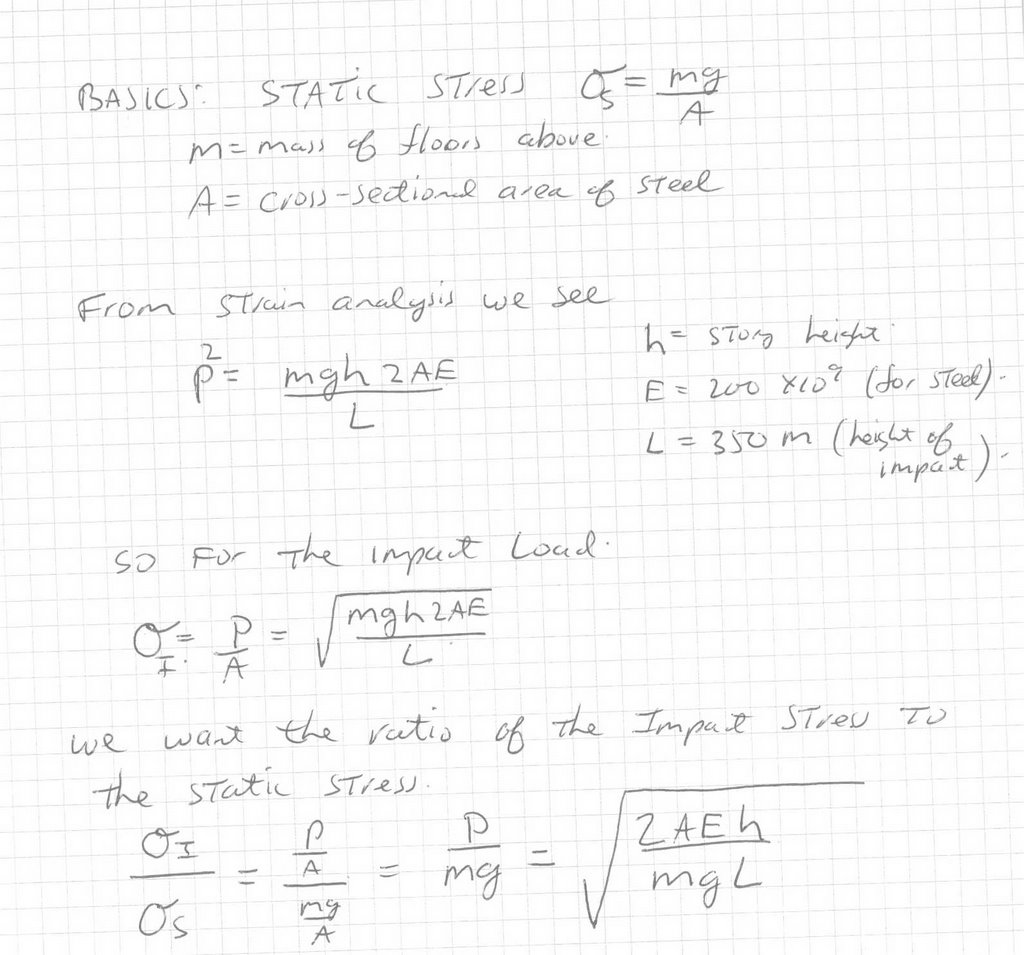

Some assumptions that are implicit to the analysis that I did and the effects of those assumptions are as follow:
- The analysis assumes that there is no material deformation of the structure. At first glance this would appear to be enough to cause my method to be invalid (after all there is a fair amount of material deformation), but I thought about it and if material deformation does take place then the analysis is invalid but the structure has already started to fail so I don't think it is that much of a restriction.
- The analysis assumes that the impact will be evenly distributed over the surface which it probably will not be. This would act to increase the dynamic stress.
- The analysis ignores the elastic compression in the tower. Since the height was so large this would probably be significant. By ignoring it the analysis that I have done here is conservative.
- I assumed that the steel structure was the same above the impact as it was at the impact. This is probably not the case (the supports were tapered) and again this would make our estimate conservative.
- I have also ignored the deformation and heat problems due to the jet striking the building. This would be very significant in the first floor or two but would be less significant as we go further down in the building.
- I should also note that after the first floor or two my analysis again goes out the window. First, you no longer have a solid (or even semi solid) object causing the impact but something like a wave of rubble. Also, as each floor falls you start to pick up kinetic energy. If the floor fails then it did not absorb all the potential energy. This leftover energy will be in the form of kinetic and at the next level you get potential and kinetic. I ignored the kinetic. What the net result of these two factors would be I haven't a clue, but I suspect that the kinetic energy would be such that it would eventually dominate the equation. Thus my analysis could show how it would start and then it is driven by the extra kinetic energy picked up as each floor collapsed.
As I said in my previous e-mail I guessed at a lot of values and came up with a crude estimate of 40 times the static load (actually it was 36). While this is a far cry from my initial guess of 2,000 (what is a factor of 50 between friends) It is still very significant.
However I wanted a better estimate and thus I went into it a little more this morning and it turns out that a lot of my assumptions (i.e. the area of steel, the height of each floor) don't matter. The important assumption is how much each floor weighs and I assumed that it was 1.5 times the weight of the steel. For the weight of the steel I used the density of steel x area of steel x height of the floor. If you don't like my 1.5 factor you can easily replace it with one of your own.
I find it hard to talk about math in an e-mail so I am attaching some scans of my work. If this is going to be put on the net you should probably go over it fairly well to check my assumptions, my equation manipulation and calculations (Editorial note: John is giving me way too much credit). My final answer is 32. Thus the dynamic load is 32 times the static load. I don't know about the WTC but for most structures a safety factor of 2 or 4 is used. I heard Dr. Thomas Eagar give a guess of a safety factor of 5. So my analysis is still 6 times this!!!
I will note that I am a mechanical engineer, not a civil one and someone with an advanced degree in structural mechanics could probably pick some holes in my analysis, but with the stipulations above I believe it is pretty sound.
John
PS I will probably be sending you e-mails with little comments on them as I think of things. For example I ignored the structural aspects of the building. For example there are areas on the floor that are designed to take only the load of the floor so even a static load of 10 times the expected load would cause failure - let alone the dynamic load!!!
-----------
John's second email:
Hi Brian:
I was going over my calculations trying to get better estimates and I realized a couple of things.
1) My h is too small (I used 3 meters but a better guess would probably be 3.7.
2) I underestimated my floor weight. I have a couple of references that say that each floor was about 4,500 t. I have no idea how they come up with this figure - it seems too high to me but the people who give it probably know more than me.
Anyway, I was looking for references and I came across this one. You have probably already read it but I found it interesting:
http://www.tam.uiuc.edu/news/200109wtc/
They used a similar approach to what I did (except they seem to have rolled up E, A and L into a single constant - probably a good idea which would save you integrating but I didn't have all the information to allow me to do it). However what I found interesting was their first estimate was a ration of dynamic load to static load of 31!!! So I think my rough value of 31.5 is actually pretty good (even though I have errors in my analysis it would appear that my errors cancelled out). In engineering sometimes it pays to be lucky instead of smart!!
Best,
John
Sunday, April 23, 2006
The Gronholm Method
In high school I had the oh-so-deep realization that artists took pop cultural fluff and turned it into high art. In my case it stemmed from seeing Norman Mailer transform your standard pulp war fiction into The Naked and The Dead, although it should have been obvious to me a lot earlier, say with Shakespeare.
Anyway, it's been done again with The Gronholm Method ("El Metodo"). This movie takes the Apprentice/Survivor concept from pop entertainment to art - an extremely well done depiction of people united in being pit against each other. It was striking to see this movie just shortly after watching "Crash" on DVD - Crash is okay, but this is a lot better. See it if you get the chance.
(For some reason, it also reminds me of a similar film for paranoid sci-fi fans, Cube.)
Anyway, it's been done again with The Gronholm Method ("El Metodo"). This movie takes the Apprentice/Survivor concept from pop entertainment to art - an extremely well done depiction of people united in being pit against each other. It was striking to see this movie just shortly after watching "Crash" on DVD - Crash is okay, but this is a lot better. See it if you get the chance.
(For some reason, it also reminds me of a similar film for paranoid sci-fi fans, Cube.)
Friday, April 21, 2006
A partisan attack on Sierra Club, from the left
Sierra Club is picking up all kinds of flack for endorsing Republican Senator Lincoln Chafee. Chafee's had a few bad votes, like every other politician, but overall has been a good environmentalist.
Firedoglake, Kos, and Atrios have all been after Sierra Club, but to the extent they criticize SC for supporting someone who voted in Bill Frist as Senate Majority Leader, they're attacking it for not being a wholly-owned subsidiary of the Democratic party, which is a ridiculous basis for the attack. (Might also be worth remembering that Frist's Republican competitors for his job were even worse than him.)
Two other points worth mentioning: while Sierra Club is non-partisan, it's no secret that its membership and likely its leadership skews somewhat to the left. When SC endorses a Republican, they're overcoming a bias, so the accusations flung against them ring hollow. Second, if you read this comment thread, it's pretty clear that the people who actually know something about Chafee are much more sympathetic to the endorsement than the fire-breathers. More evidence suggesting the fire-breathers and the bloggers got it wrong.
Firedoglake, Kos, and Atrios have all been after Sierra Club, but to the extent they criticize SC for supporting someone who voted in Bill Frist as Senate Majority Leader, they're attacking it for not being a wholly-owned subsidiary of the Democratic party, which is a ridiculous basis for the attack. (Might also be worth remembering that Frist's Republican competitors for his job were even worse than him.)
Two other points worth mentioning: while Sierra Club is non-partisan, it's no secret that its membership and likely its leadership skews somewhat to the left. When SC endorses a Republican, they're overcoming a bias, so the accusations flung against them ring hollow. Second, if you read this comment thread, it's pretty clear that the people who actually know something about Chafee are much more sympathetic to the endorsement than the fire-breathers. More evidence suggesting the fire-breathers and the bloggers got it wrong.
Monday, April 17, 2006
Bush's second speech this August
For context, you might want to read the Bush's first speech on August 16th of this year.
Official White House Transcript
August 21, 2006
Speech by President Bush giving 48 hours to Iranian dictator Ahmadinejad to step down and end radiological threats from Iran
Good evening.
When I spoke to you last, five days ago, I announced that American forces had taken the decisive step to end the nuclear bomb threat from Iran. Our forces successfully destroyed the machinery that we know to be designed for nuclear weapons, not nuclear power. To save American lives and Iranian lives too, American forces used a fission-enhanced penetration weapon to destroy the Natanz gas centrifuge. Fission-enhanced penetration should not be considered nuclear bombing, as has been made quite clear.
Our necessary action made the mistake of the Iranian dictator equally clear. "President" Ahmadinejad brought this situation on his country by his dangerous pursuit of a new Holocaust, a nuclear Holocaust. We stopped him. History will be clear - we did the right thing.
Yesterday, President Ahmadinejad compounded his mistake. The crowds he spoke to in Tehran were brought there using a combination of force, hysteria, and lies. Whatever misleading images have been shown by the media, the Iranian people as a whole know that we want to help them, they love freedom, and they oppose their dictator.
Just a small, fanatical few support the dictator mullahs, but these few people control all the power. Fanning the hysteria, maybe even believing it himself, Ahmadinejad accuses us of attacking them with nuclear bombs. That is a lie. We did not use nuclear bombs; we used one fission-enhanced weapon. We did not start this confrontation; as stated before, our evidence leaves no doubt that Iran planned to distribute nuclear bombs to terrorists. Self-defense is not an attack.
Ahmadinejad then took a fatal step - he said in retaliation for raining "nuclear fire" on his own people, Iran will "soon" explode a radiological bomb at an American government or military facility within a major US city. The "nuclear fire" is a lie; we did not use a nuclear bomb, and all the military facilities that we hit were carefully targeted to minimize civilian casualties. Iran's dictators have no right to retaliate against something we had to do in self-defense.
While we have eliminated the greatest threat, Iranian nuclear bombs, a severe threat has now arisen from this planned "dirty bomb" attack. We have to take direct action to counter this new threat. To those who disagreed with our decision for pre-emptive self-defense in Iran, the need for self-defense should now be clear. Hindsight is not wisdom, but foresight about an open threat to our cities is simply obvious. We must remove Ahmadinejad and eliminate the threat he poses.
President Ahmadinejad has 48 hours to resign. A man this dangerous can no longer rule the country. Iran's subsequent leader must, in the same time period, renounce any plan to subject the United States to radiological attack, and open all nuclear facilities to UN inspection and inventory. If this deadline is missed, Operation Persian Freedom will begin.
We have made it clear to the Iranian people that our problem is not with them, but with the dictators who stole their country. Their freedom and sovereignty will be returned to them from the dictator mullahs who robbed them.
This dangerous world requires both courage and hope. I know our brave American soldiers have both courage and hope; I know the brave American people do as well. Moving forward today, we save Iran and save our own country.
May God bless America's work, and may God bless us all.
Official White House Transcript
August 21, 2006
Speech by President Bush giving 48 hours to Iranian dictator Ahmadinejad to step down and end radiological threats from Iran
Good evening.
When I spoke to you last, five days ago, I announced that American forces had taken the decisive step to end the nuclear bomb threat from Iran. Our forces successfully destroyed the machinery that we know to be designed for nuclear weapons, not nuclear power. To save American lives and Iranian lives too, American forces used a fission-enhanced penetration weapon to destroy the Natanz gas centrifuge. Fission-enhanced penetration should not be considered nuclear bombing, as has been made quite clear.
Our necessary action made the mistake of the Iranian dictator equally clear. "President" Ahmadinejad brought this situation on his country by his dangerous pursuit of a new Holocaust, a nuclear Holocaust. We stopped him. History will be clear - we did the right thing.
Yesterday, President Ahmadinejad compounded his mistake. The crowds he spoke to in Tehran were brought there using a combination of force, hysteria, and lies. Whatever misleading images have been shown by the media, the Iranian people as a whole know that we want to help them, they love freedom, and they oppose their dictator.
Just a small, fanatical few support the dictator mullahs, but these few people control all the power. Fanning the hysteria, maybe even believing it himself, Ahmadinejad accuses us of attacking them with nuclear bombs. That is a lie. We did not use nuclear bombs; we used one fission-enhanced weapon. We did not start this confrontation; as stated before, our evidence leaves no doubt that Iran planned to distribute nuclear bombs to terrorists. Self-defense is not an attack.
Ahmadinejad then took a fatal step - he said in retaliation for raining "nuclear fire" on his own people, Iran will "soon" explode a radiological bomb at an American government or military facility within a major US city. The "nuclear fire" is a lie; we did not use a nuclear bomb, and all the military facilities that we hit were carefully targeted to minimize civilian casualties. Iran's dictators have no right to retaliate against something we had to do in self-defense.
While we have eliminated the greatest threat, Iranian nuclear bombs, a severe threat has now arisen from this planned "dirty bomb" attack. We have to take direct action to counter this new threat. To those who disagreed with our decision for pre-emptive self-defense in Iran, the need for self-defense should now be clear. Hindsight is not wisdom, but foresight about an open threat to our cities is simply obvious. We must remove Ahmadinejad and eliminate the threat he poses.
President Ahmadinejad has 48 hours to resign. A man this dangerous can no longer rule the country. Iran's subsequent leader must, in the same time period, renounce any plan to subject the United States to radiological attack, and open all nuclear facilities to UN inspection and inventory. If this deadline is missed, Operation Persian Freedom will begin.
We have made it clear to the Iranian people that our problem is not with them, but with the dictators who stole their country. Their freedom and sovereignty will be returned to them from the dictator mullahs who robbed them.
This dangerous world requires both courage and hope. I know our brave American soldiers have both courage and hope; I know the brave American people do as well. Moving forward today, we save Iran and save our own country.
May God bless America's work, and may God bless us all.
Tuesday, April 11, 2006
How they'll spin it, coming this August
My crystal ball showed me this speech by President Bush this upcoming August. More information on the factual background is here.
Be prepared.
Official White House Transcript
August 16, 2006
Speech by President Bush authorizing use of fission-enhanced penetration weapon to end Iran's nuclear bomb-making
Good evening.
Earlier today, I took the step that we have delayed as long as humanly possible, and authorized military action to end Iran's dangerous and illegal nuclear bomb-making program. Our brave fighting men and women have begun military operations, and all reports show that we have been successful in our efforts.
The dictator mullahs of Iran have denied they are creating nuclear bombs, but their lies can no longer be tolerated or excused. We simply cannot wait any longer. Every day that they continue purifying weapons-grade uranium brings us closer to the day when a terrorist nuclear bomb will explode in America, in Israel, and elsewhere in the West, causing countless civilian casualties. And these faceless terrorists would have not one nuclear bomb, but dozen or more, giving small groups of heartless fanatics the capacity to wage a world war. We have to stop them.
This danger to the world is not a risk, it is a certainty. The documentary evidence that the Secretary of State will present to the UN Security Council tomorrow will prove that Iranian mullahs planned to develop and distribute nuclear bombs to terrorists. We had to act, and we had to act now.
Iran's dictatorial leaders, together with some sincere-but-misguided Americans, accuse us of planning this operation for months. While we have to make advance plans, we never wanted to go forward with it. The Iranian dictators left the world without a choice.
The dictators and their misguided supporters here also accused us of planning to use nuclear bombs against Iran. Now we all have seen pictures of the devastation caused by gigantic nuclear bombs, both in tests and in the horrible, and necessary, bombing of Hiroshima that ended the Second World War. This is unthinkable - we would not use nuclear bombs such as these, and we have not done so.
The term "nuclear bomb" should appropriately belong to these massive, city-destroying weapons. To stop Iran's effort to make many such nuclear bombs, we have used something else. Typical convential weapons cannot reach the heart of Iran's weaponry program, the uranium gas centrifuges of Natanz, buried under seventy-five feet of shielding. If we were to shut down Iran's program with typical weaponry, we would have had to attack hundreds of "softer" targets, where the mullahs have made human shield hostages of their civiliam population. Or we would have had to launch risky ground operations in Natanze, causing the unnecessary deaths of American servicemen and women. Others may support the unnecessary death of American warriors defending our country, but I cannot.
The fission-enhanced penetration weapon that earlier today, breached and destroyed the Natanz nuclear bomb program, should not be considered a nuclear bomb itself. It is a destroyer of nuclear bombs and a saver of human life. The enhanced weapon does not have the destructive size or destructive intent of real nuclear bombs, and belongs in a separate class for military operations. The weapon, modified to maximize bunker-busting with very little radiation, was a success. We believe that any radiation now escaping from Natanz is from the destroyed uranium centrifuge operation, and the mullahs can only blame themselves for that problem.
With the Natanz operation destroyed, we have had to attack far fewer targets elsewhere in Iran. We believe that few if any civilians were harmed.
While it is unfortunate that we had to take this step, America and the world is better off for us having done so.
There is little chance that the Iranian dictatorship will learn from this mistake, but we know the Iranian people will see how the mullahs betrayed them and forced this attack. We extend our hand in friendship to the Iranian people, and we will gladly help them in their legitimate wish to be free.
We are all safer now, thanks to the bravery of our men and women in uniform. Our prayers are with them as they return, and we know all good-thinking people will support our troops in their own prayers.
May all our efforts for peace be rewarded, and may God bless America.
Be prepared.
Official White House Transcript
August 16, 2006
Speech by President Bush authorizing use of fission-enhanced penetration weapon to end Iran's nuclear bomb-making
Good evening.
Earlier today, I took the step that we have delayed as long as humanly possible, and authorized military action to end Iran's dangerous and illegal nuclear bomb-making program. Our brave fighting men and women have begun military operations, and all reports show that we have been successful in our efforts.
The dictator mullahs of Iran have denied they are creating nuclear bombs, but their lies can no longer be tolerated or excused. We simply cannot wait any longer. Every day that they continue purifying weapons-grade uranium brings us closer to the day when a terrorist nuclear bomb will explode in America, in Israel, and elsewhere in the West, causing countless civilian casualties. And these faceless terrorists would have not one nuclear bomb, but dozen or more, giving small groups of heartless fanatics the capacity to wage a world war. We have to stop them.
This danger to the world is not a risk, it is a certainty. The documentary evidence that the Secretary of State will present to the UN Security Council tomorrow will prove that Iranian mullahs planned to develop and distribute nuclear bombs to terrorists. We had to act, and we had to act now.
Iran's dictatorial leaders, together with some sincere-but-misguided Americans, accuse us of planning this operation for months. While we have to make advance plans, we never wanted to go forward with it. The Iranian dictators left the world without a choice.
The dictators and their misguided supporters here also accused us of planning to use nuclear bombs against Iran. Now we all have seen pictures of the devastation caused by gigantic nuclear bombs, both in tests and in the horrible, and necessary, bombing of Hiroshima that ended the Second World War. This is unthinkable - we would not use nuclear bombs such as these, and we have not done so.
The term "nuclear bomb" should appropriately belong to these massive, city-destroying weapons. To stop Iran's effort to make many such nuclear bombs, we have used something else. Typical convential weapons cannot reach the heart of Iran's weaponry program, the uranium gas centrifuges of Natanz, buried under seventy-five feet of shielding. If we were to shut down Iran's program with typical weaponry, we would have had to attack hundreds of "softer" targets, where the mullahs have made human shield hostages of their civiliam population. Or we would have had to launch risky ground operations in Natanze, causing the unnecessary deaths of American servicemen and women. Others may support the unnecessary death of American warriors defending our country, but I cannot.
The fission-enhanced penetration weapon that earlier today, breached and destroyed the Natanz nuclear bomb program, should not be considered a nuclear bomb itself. It is a destroyer of nuclear bombs and a saver of human life. The enhanced weapon does not have the destructive size or destructive intent of real nuclear bombs, and belongs in a separate class for military operations. The weapon, modified to maximize bunker-busting with very little radiation, was a success. We believe that any radiation now escaping from Natanz is from the destroyed uranium centrifuge operation, and the mullahs can only blame themselves for that problem.
With the Natanz operation destroyed, we have had to attack far fewer targets elsewhere in Iran. We believe that few if any civilians were harmed.
While it is unfortunate that we had to take this step, America and the world is better off for us having done so.
There is little chance that the Iranian dictatorship will learn from this mistake, but we know the Iranian people will see how the mullahs betrayed them and forced this attack. We extend our hand in friendship to the Iranian people, and we will gladly help them in their legitimate wish to be free.
We are all safer now, thanks to the bravery of our men and women in uniform. Our prayers are with them as they return, and we know all good-thinking people will support our troops in their own prayers.
May all our efforts for peace be rewarded, and may God bless America.
Bob Carter won't bet over global warming
Following Tim Lambert's post on Bob Carter, I emailed Professor Carter to see if he would bet me over global warming, offering 2:1 odds that temperatures will increase in 10 years.
He politely emailed me back, saying that because temperature change is a random walk, he won't bet me. I've replied to say that doesn't make sense.
Either he doesn't believe temperature changes are random, or he should bet me.
He politely emailed me back, saying that because temperature change is a random walk, he won't bet me. I've replied to say that doesn't make sense.
Either he doesn't believe temperature changes are random, or he should bet me.
Monday, April 10, 2006
Adjusting Kyoto requirements for low-population-density nations
I'm too cheap to pay and read the whole article, but New Scientist is highlighting proposals to adjust carbon emission requirements from countries with low population densities:
I welcome the concept of introducing equity and fairness into the Kyoto targets, but I think my idea of allocating per-capita emissions worldwide would accomplish the same purpose. The per-capita emissions, allocated worldwide and then aggregated for each nation, should be net emissions, so low-density countries will have the opportunity to use their forests etc. as a sink to reduce their emissions. Reduce emissions enough, and then the low density nation can sell part of its emission quota to other nations.
The presence of carbon sinks in low-density nations is/should be a double-edged sword, though. If a nation screws with its carbon sink, say by cutting down the trees, then it has added to the net emissions from the country. That should be part of the climate management picture.
Their rationale is that large countries have more natural vegetation to absorb pollution, and more fields and forests to provide natural resources for the world. So they should be entitled to a larger ecological footprint than small, densely populated countries.
I welcome the concept of introducing equity and fairness into the Kyoto targets, but I think my idea of allocating per-capita emissions worldwide would accomplish the same purpose. The per-capita emissions, allocated worldwide and then aggregated for each nation, should be net emissions, so low-density countries will have the opportunity to use their forests etc. as a sink to reduce their emissions. Reduce emissions enough, and then the low density nation can sell part of its emission quota to other nations.
The presence of carbon sinks in low-density nations is/should be a double-edged sword, though. If a nation screws with its carbon sink, say by cutting down the trees, then it has added to the net emissions from the country. That should be part of the climate management picture.
Sunday, April 09, 2006
Ghosts of Rwanda
The PBS documentary Ghosts of Rwanda does an excellent and gut-wrenching job of describing the genocide in Rwanda in 1994, and how little the outside world did to prevent it. The movie is very hard to watch, but worth watching. While film-makers never overtly express an opinion as to who tried to help and who stood in the way on the international scene, we can draw some conclusions. Two people I've generally liked, Kofi Annan and Richard Clarke, don't come off well. Annan, head of UN Peacekeeping at the time, blocked numerous attempts by the hard-charging Canadian general managing UN forces there from taking more active steps to stop the slaughter. Clarke blocked Madeleine Albright's attempt to be slightly more active, and he refused to be interviewed for the show as well, which sounds like an admission of guilt to me. As an American documentary, it appropriately focuses on American inaction, but other countries, especially Belgium, have plenty to answer for as well. I hope that's happening.
I also wanted to recognize the heroism of an unarmed Segalese officer, Captain Mbaye, detailed to the UN team. He used nothing more than charm to negotiate his way through numerous roadblocks manned by crazed murderers, and conducted a completely unauthorized human smuggling operation that saved hundreds of people, while world leaders did nothing. Random mortar fire killed him in the last days of the genocide. More information is here. How he did it and even what he did remains mysterious. He deserves his own movie.
I also wanted to recognize the heroism of an unarmed Segalese officer, Captain Mbaye, detailed to the UN team. He used nothing more than charm to negotiate his way through numerous roadblocks manned by crazed murderers, and conducted a completely unauthorized human smuggling operation that saved hundreds of people, while world leaders did nothing. Random mortar fire killed him in the last days of the genocide. More information is here. How he did it and even what he did remains mysterious. He deserves his own movie.
Saturday, April 08, 2006
Declassifying versus leaking depends on intent
Juliette Kayyem and Jane Hamsher both pushed the ball forward on whether Bush's apparent command to reveal classified information was legal. Kayyem points out that declassification has to be in the public interest, and the reference to public interest makes it illogical to assume the "declassification" could be for a single member of the public, Judith Miller. Hamsher highlights the apparent lack of documentation that information was declassified. An update to her post points out that the information was apparently deemed classified afterwards.
While some legal experts say the President has the authority to declassify information at will, that doesn't mean Bush actually declassified the information. For reasons of his own (say, to smear someone without leaving his fingerprints on the smear), Bush may have kept the information classified, but commanded that it be leaked. The apparent fact that it was classified afterwards suggests this is what happened. That would make the disclosure illegal.
The twist I take on Kayyem's post is that if information is declassified to the point where a member of the public (Judith Miller) can have it, then it's completely declassified. Because it apparently was classified afterwards, then Bush didn't declassify it - he illegally leaked.
The only legal way out I can see for Bush is to claim he declassified the information and then at some point after the authorization, but before reporters starting asking for it, he or someone else reclassified it. To use this escape route, they need to claim it and prove it - where's the documentation for the reclassification? And it creates even more political problems for them of using governmental secrets for political advantage, and making Clintonian excuses as to why they didn't break the law. Except in Bush's case, it concerns national security.
While some legal experts say the President has the authority to declassify information at will, that doesn't mean Bush actually declassified the information. For reasons of his own (say, to smear someone without leaving his fingerprints on the smear), Bush may have kept the information classified, but commanded that it be leaked. The apparent fact that it was classified afterwards suggests this is what happened. That would make the disclosure illegal.
The twist I take on Kayyem's post is that if information is declassified to the point where a member of the public (Judith Miller) can have it, then it's completely declassified. Because it apparently was classified afterwards, then Bush didn't declassify it - he illegally leaked.
The only legal way out I can see for Bush is to claim he declassified the information and then at some point after the authorization, but before reporters starting asking for it, he or someone else reclassified it. To use this escape route, they need to claim it and prove it - where's the documentation for the reclassification? And it creates even more political problems for them of using governmental secrets for political advantage, and making Clintonian excuses as to why they didn't break the law. Except in Bush's case, it concerns national security.
Tuesday, April 04, 2006
March 2006 Iraq casualties
(Sorry, missed doing the February report.)
Avg. daily military fatality rate (nearly all of them Americans): 1.06. February was 2.07, January 2.06, and March 2005 was 1.26. Overall average to date is 2.3, down .03 from January. Total US dead as of today: 2343.
Iraqi monthly military/police fatalities: 193. February was 158, January was 189 and March 2005 was 176. Total dead: 4397.
Iraqi monthly civilian fatalities: 901. February was 688, January was 579, and March 2005 was 240. Note that the civilian numbers may be less accurate than others, but could still be useful in determining trends.
Comments: The American death rate has dropped somewhat in the last few months. That doesn't seem to have changed public pessimism - Americans appear to be tired of seeing hundreds of American dead annually as we enter the fourth year of the war.
Either the Iraqi civilian body count is low, or media overplayed the civil strife that resulted from blowing up the Shiite shrine towards the end of February. I recall seeing reports about thousands of deaths in sectarian violence.
Avg. daily military fatality rate (nearly all of them Americans): 1.06. February was 2.07, January 2.06, and March 2005 was 1.26. Overall average to date is 2.3, down .03 from January. Total US dead as of today: 2343.
Iraqi monthly military/police fatalities: 193. February was 158, January was 189 and March 2005 was 176. Total dead: 4397.
Iraqi monthly civilian fatalities: 901. February was 688, January was 579, and March 2005 was 240. Note that the civilian numbers may be less accurate than others, but could still be useful in determining trends.
Comments: The American death rate has dropped somewhat in the last few months. That doesn't seem to have changed public pessimism - Americans appear to be tired of seeing hundreds of American dead annually as we enter the fourth year of the war.
Either the Iraqi civilian body count is low, or media overplayed the civil strife that resulted from blowing up the Shiite shrine towards the end of February. I recall seeing reports about thousands of deaths in sectarian violence.
Sunday, April 02, 2006
9/11 Conspiracy post in progress, and it's not working
One of the many reasons offered to back the claim that 9/11 was a conspiracy is that the buildings fell at or near to a free-fall speed. I suspect the answer is here:
"The buildings did fall quickly - almost (but not exactly) at the same speed as if there was no resistance. Shouldn't the floors below have slowed it down? The huge dynamic loads due to the very large momentum of the upper floors falling were so great that they smashed through the lower floors very quickly. The columns were not designed to carry these huge loads and they provided little resistance."
It would be better to do this mathematically, though.
So we've got:
"A kilogram force,
for instance, is the force exerted by gravity on a mass of 1 kg.
1 kgf = (1 kg)(9.8 m/s^2) = 9.8 Newtons"
And kinetic energy from a falling object:
KE = (mass x velocity2)/2 or 1/2 mv2 (KE measured in joules)
And:
newtons multiplied by meters equal joules
So if I divide the KE by the distance the object has fallen in meters, I should get the dynamic load in newtons exerted by the object on the thing it hit, which I could then compare the static load exerted by the object on the support? Seems like it should work, but what do I know.
So using simplified numbers, let's pretend that stories 99-110 of the World Trade Center weighed 1 kilogram (don't like that? okay, we're just discussing failure of a tiny vertical cross section weighing a total of one kilo). A plane hits floor 98, impact blows away fire insulation, fire weakens (doesn't melt) steel, steel buckles, floor collapses, and now floors 98-110 collapse and fall 3 meters to floor 97. Floor 98 collapsed when its strength diminished below the force exerted by 1 kilo, or 9.8 newtons. What's the force that will be exerted by slightly over 1 kilo after a 3 meter fall?
I need to know the velocity, dammit. Now I'm tired of this. Found a calculator, here. It says the KE is 29.4 joules. Divide by 3 and you get 9.8 newtons. Dammit again, I'm defeated by the conservation of energy - I must be just measuring transfer between potential energy and kinetic energy. So how do you derive and compare static versus dynamic loads?
UPDATE: People in the comments are doing a much better job with this than I did.
"The buildings did fall quickly - almost (but not exactly) at the same speed as if there was no resistance. Shouldn't the floors below have slowed it down? The huge dynamic loads due to the very large momentum of the upper floors falling were so great that they smashed through the lower floors very quickly. The columns were not designed to carry these huge loads and they provided little resistance."
It would be better to do this mathematically, though.
So we've got:
"A kilogram force,
for instance, is the force exerted by gravity on a mass of 1 kg.
1 kgf = (1 kg)(9.8 m/s^2) = 9.8 Newtons"
And kinetic energy from a falling object:
KE = (mass x velocity2)/2 or 1/2 mv2 (KE measured in joules)
And:
newtons multiplied by meters equal joules
So if I divide the KE by the distance the object has fallen in meters, I should get the dynamic load in newtons exerted by the object on the thing it hit, which I could then compare the static load exerted by the object on the support? Seems like it should work, but what do I know.
So using simplified numbers, let's pretend that stories 99-110 of the World Trade Center weighed 1 kilogram (don't like that? okay, we're just discussing failure of a tiny vertical cross section weighing a total of one kilo). A plane hits floor 98, impact blows away fire insulation, fire weakens (doesn't melt) steel, steel buckles, floor collapses, and now floors 98-110 collapse and fall 3 meters to floor 97. Floor 98 collapsed when its strength diminished below the force exerted by 1 kilo, or 9.8 newtons. What's the force that will be exerted by slightly over 1 kilo after a 3 meter fall?
I need to know the velocity, dammit. Now I'm tired of this. Found a calculator, here. It says the KE is 29.4 joules. Divide by 3 and you get 9.8 newtons. Dammit again, I'm defeated by the conservation of energy - I must be just measuring transfer between potential energy and kinetic energy. So how do you derive and compare static versus dynamic loads?
UPDATE: People in the comments are doing a much better job with this than I did.
Friday, March 31, 2006
The Reasonable Libertarian approach to polygamy
There's been a lot of blogosphere hand-wringing over polygamy lately, occasioned by some polygamy-themed TV show I don't feel a need to see called "Big Love." Much of the hand-wringing comes from people who embrace the libertarian arguments for gay marriage, and then have problems applying the same principles to polygamy.
The non-libertarian perspective is oppressive, while the hard-core libertarian is unrealistic. The Reasonable Libertarian approach is better - we agree that adults should control their destinies, but accept a transitional period where young adults assume their autonomy over time, and don't acquire full rights until the end.
So:
1. No one under the age of 25 can be in a polygamous marriage.
2. Everyone in a marriage must consent (or be divorced) before an additional person is added.
3. Economic benefits from society (like survivor benefits from Social Security) are given to only one person or are divided proportionally among a person's spouses.
The age limit and consent provisions would prevent much of the exploitation we see with polygamy, and dividing economic benefits would stop it from being unfair to the rest of society. Yes, there will be some 25 year olds who will enter exploitative relationships, but at that age one can say it was much more of a choice than for an 18-year old.
I expect in modern societies with modern education, modern life spans, and modern divorce rates, the specter of countless "unmarriageable males" who can't find a wife and degenerate into warlike behavior is also unlikely.
Is this really so hard?
P.S. Krakauer's book on Mormon fundamentalists and polygamy, Under the Banner of Heaven, is excellent.
The non-libertarian perspective is oppressive, while the hard-core libertarian is unrealistic. The Reasonable Libertarian approach is better - we agree that adults should control their destinies, but accept a transitional period where young adults assume their autonomy over time, and don't acquire full rights until the end.
So:
1. No one under the age of 25 can be in a polygamous marriage.
2. Everyone in a marriage must consent (or be divorced) before an additional person is added.
3. Economic benefits from society (like survivor benefits from Social Security) are given to only one person or are divided proportionally among a person's spouses.
The age limit and consent provisions would prevent much of the exploitation we see with polygamy, and dividing economic benefits would stop it from being unfair to the rest of society. Yes, there will be some 25 year olds who will enter exploitative relationships, but at that age one can say it was much more of a choice than for an 18-year old.
I expect in modern societies with modern education, modern life spans, and modern divorce rates, the specter of countless "unmarriageable males" who can't find a wife and degenerate into warlike behavior is also unlikely.
Is this really so hard?
P.S. Krakauer's book on Mormon fundamentalists and polygamy, Under the Banner of Heaven, is excellent.
Thursday, March 30, 2006
Mom, the criminal
Email from my mother:
We have a plot. From Sister Ann, who spoke to us last week, we get an undocumented worker to attend a church dinner or one at our home, everyone who comes brings a dish, we feed the worker, then all go to the police and confess. That is, if the Sensenbrenner law passes. Many of us in the church have been writing, faxing, phoning our lawmakers and Bush. A legislative aide told us 2 weeks ago that representatives pay more attention to volume of mail than to polls. So we need to get the volume up.
Love,
Mom
I guess the "persecuted Christian" meme on the right might finally have some validity to it.
We have a plot. From Sister Ann, who spoke to us last week, we get an undocumented worker to attend a church dinner or one at our home, everyone who comes brings a dish, we feed the worker, then all go to the police and confess. That is, if the Sensenbrenner law passes. Many of us in the church have been writing, faxing, phoning our lawmakers and Bush. A legislative aide told us 2 weeks ago that representatives pay more attention to volume of mail than to polls. So we need to get the volume up.
Love,
Mom
I guess the "persecuted Christian" meme on the right might finally have some validity to it.
Friday, March 24, 2006
Located at last! The elusive, conservative science blogger!
Several months ago, I was given a quest to find a science blogger who also expressed conservative politics. I found nothing, and while I vaguely remembered some dinosaur-themed blog, I couldn't nail that one down either. No more.
Meet the conservative science blog,
Well, that's done. Happy, Kevin?
Meet the conservative science blog,
Deinonychus antirrhopus
Well, that's done. Happy, Kevin?
Thursday, March 23, 2006
I better kick him before he's gone
Washingtonpost.com's new hard core right-wing blogger, Ben Domenech of the group blog Redstate.org, appears to have a plagiarism problem. I assume he's not going to last for very long. No response to the plagiarism accusation on his blog yet, just some partial retractions of other mistakes.
So before he's gone, can I just mention that Redstate bloggers denied global warming, and then never replied to my challenge to bet over it? I suppose I should also say it was his fellow bloggers putting out the nonsense, but I don't notice him refuting them either.
So before he's gone, can I just mention that Redstate bloggers denied global warming, and then never replied to my challenge to bet over it? I suppose I should also say it was his fellow bloggers putting out the nonsense, but I don't notice him refuting them either.
Wednesday, March 22, 2006
Terrible lawprof commentary on NPR, and a blogging note
National Public Radio this morning had a terrible commentary by law professor Douglas Kmiec on the wiretapping issue, and I thought it was terrible even before I realized he was a conservative prof.
The first thing that struck me was his saying it was inappropriate for Congress to bring up extreme hypothetical examples. A basic tool of legal analysis is to use hypothetical examples, and "fighting the hypothetical" is a classic mistake for law students in their first-ever classes. If your legal principle can't handle hypothetical examples at all levels you intend to apply it, that means there's something wrong with your principle. If your legal principle is butting up against other legal principles, that's fine - acknowledge the potential conflict and draw boundaries as best you can. In Bush's case, he isn't acknowledging any countervailing principle to stand up to the "unitary executive power," so he has even less excuse - if you take an extreme position, let's see you defend it.
Second was his saying that he purposefully gave a vague answer to a vague question, leaving it to his congressional audience to think about nuances. You're the expert, man, you provide the nuance and use it to demonstrate what legal principles are in play.
Third was telling Congress to ignore the majority opinion in a Supreme Court case examining executive power and listen to the concurring opinion instead. Majority opinion = the law, while concurring opinion = not the law.
Fourth was his emphasis on the concurring opinion statement that they shouldn't examine hypotheticals. That MIGHT be reasonable advice to a court that's supposed to limit itself to a particular case or controversy, but it's ridiculous to apply it to a Congress that's supposed to set broad policy covering a range of issues.
Fifth, and the only overtly political issue, was his saying Congress and the President need to show mutual resolve. It was Bush that refused to seek Congressional authorization for his wiretapping, and given what over-broad latitude he's being allowed now, his inaction must be because he wanted no real oversight at all. In other words, Kmiec is lecturing to the wrong side on the issue of working together.
Very unimpressive, but probably the best that the pro-wiretappers could come up with.
And now my completely different note - I haven't been blogging much lately. My interest ebbs and flows between blogging myself and commenting on other peoples' blogs, and I've also been busy. I'm very glad and grateful that some folks want to hear what I've got to say. I do expect to blog from time to time, but at a reduced rate, so you might want to use an RSS feed as a more efficient way to see if I've posted instead of checking the website itself. Regardless, thanks for stopping by!
The first thing that struck me was his saying it was inappropriate for Congress to bring up extreme hypothetical examples. A basic tool of legal analysis is to use hypothetical examples, and "fighting the hypothetical" is a classic mistake for law students in their first-ever classes. If your legal principle can't handle hypothetical examples at all levels you intend to apply it, that means there's something wrong with your principle. If your legal principle is butting up against other legal principles, that's fine - acknowledge the potential conflict and draw boundaries as best you can. In Bush's case, he isn't acknowledging any countervailing principle to stand up to the "unitary executive power," so he has even less excuse - if you take an extreme position, let's see you defend it.
Second was his saying that he purposefully gave a vague answer to a vague question, leaving it to his congressional audience to think about nuances. You're the expert, man, you provide the nuance and use it to demonstrate what legal principles are in play.
Third was telling Congress to ignore the majority opinion in a Supreme Court case examining executive power and listen to the concurring opinion instead. Majority opinion = the law, while concurring opinion = not the law.
Fourth was his emphasis on the concurring opinion statement that they shouldn't examine hypotheticals. That MIGHT be reasonable advice to a court that's supposed to limit itself to a particular case or controversy, but it's ridiculous to apply it to a Congress that's supposed to set broad policy covering a range of issues.
Fifth, and the only overtly political issue, was his saying Congress and the President need to show mutual resolve. It was Bush that refused to seek Congressional authorization for his wiretapping, and given what over-broad latitude he's being allowed now, his inaction must be because he wanted no real oversight at all. In other words, Kmiec is lecturing to the wrong side on the issue of working together.
Very unimpressive, but probably the best that the pro-wiretappers could come up with.
And now my completely different note - I haven't been blogging much lately. My interest ebbs and flows between blogging myself and commenting on other peoples' blogs, and I've also been busy. I'm very glad and grateful that some folks want to hear what I've got to say. I do expect to blog from time to time, but at a reduced rate, so you might want to use an RSS feed as a more efficient way to see if I've posted instead of checking the website itself. Regardless, thanks for stopping by!
Wednesday, March 08, 2006
Am I just another Fred Hutchison? What would Richard Lindzen say?
Fred Hutchison is an idiot (no, that's not enough to answer the first question posed above) who thinks he's smarter than Darwin AND Einstein, and also thinks he's disproven the scientific consensus on global warming. But when I read his incredibly smarmy replay of how he supposedly out-debated scientists defending Einstein and global warming, I thought I saw a little of myself in his style. (I didn't bother reading the Einstein stuff; the global warming stuff was beyond ridiculous, and Belette refutes him here.)
The overlap between me and my man Fred comes in the form of Richard Lindzen, one of a very small number of respected climatologists that disagree with the consensus position on global warming. I have to concede from the outset that Lindzen knows more than I do about climate, and can even understand better than I can whatever comes out in the form of new research. Who am I to say that Lindzen is wrong? This is a relevant question to more people than just me - how is a high school graduate supposed to judge a Creationist lecturer who has a Master's degree in Biology?
This might not be too relevant to the science bloggers on my blogroll - they ARE the experts in their field. The rest of us need to consider it though.
I think there are several ways to judge someone with superior knowledge without being another Fred:
All the above requires some knowledge of the field, but I think it's enough to allow an amateur to judge between experts. And, Dr. Lindzen, if you think I'm still just another Fred, please feel free to bet me over it.
The overlap between me and my man Fred comes in the form of Richard Lindzen, one of a very small number of respected climatologists that disagree with the consensus position on global warming. I have to concede from the outset that Lindzen knows more than I do about climate, and can even understand better than I can whatever comes out in the form of new research. Who am I to say that Lindzen is wrong? This is a relevant question to more people than just me - how is a high school graduate supposed to judge a Creationist lecturer who has a Master's degree in Biology?
This might not be too relevant to the science bloggers on my blogroll - they ARE the experts in their field. The rest of us need to consider it though.
I think there are several ways to judge someone with superior knowledge without being another Fred:
- Judge the debate, not the analysis. While I can't refute Lindzen, Real Climate can. Even with just amateur knowledge of the issues, I think RC has nailed Lindzen to a post. While a little knowledge may be dangerous, a little more on top of that could be helpful. With that much, you can figure out who won the argument. For what it's worth, this is how the adversarial legal model works - judges aren't expected to become experts in the trial issues, but rather to know enough to judge which of the two expert lawyers at trial is correct.
- A strong consensus means something - if 4 out 5 dentists recommend sugarless gum, do you go and stuff sugar into your mouth or not? Maybe that one single dentist or one climatologist is right, but the odds aren't looking good, and meanwhile we have to make a decision. This may not be a purely scientific response, but the real question is about what policy recommendations to make - do we teach Creationism in schools this year? Do we increase the gas tax? An expert consensus suggests which way to lean on these questions, and Lindzen is far outside of the mainstream.
- Examine the experts for sincerity. Some years ago I attended a lecture by Steve Schneider where he showed a graph depicting top climatogists' "uncertainty range" for projected temperature changes. All of them had large uncertainty ranges, except for Lindzen. That unwarranted confidence completely undermined him in my eyes. The RC post linked above also showed arguments that Lindzen must have known and ignored in his presentations. If someone is hiding something, it's because his argument is weak.
All the above requires some knowledge of the field, but I think it's enough to allow an amateur to judge between experts. And, Dr. Lindzen, if you think I'm still just another Fred, please feel free to bet me over it.
Sunday, March 05, 2006
Abortion different from ending pregnancy
William Saletan has an interesting Op-Ed in today's Washington Post, arguing that technology is making first-trimester abortions increasingly easy, while making people more ethically-troubled about second-trimester abortions. He suggests the great abortion debate could be mostly resolved by easy access to contraception and early-abortion methods, while later abortions become discouraged and rare.
I agree that the physical similarity of an older fetus to a baby will increasingly make a distinction in people's minds about the ethics of abortion in those cases, although what I think should really matter is brain function and development, not body shape. Technology could take this issue one step further though.
Saletan writes about how medical advances have pushed fetal viability to ever-earlier stages. A point he doesn't touch on is how this could ultimately solve the infringement of bodily autonomy, where women are forced to remain pregnant for the sake of the fetus. I think the day won't be that far away when women can end (abort) their pregnancies any time after the first twelve weeks without killing the fetus. Women then would retain bodily autonomy, but lose the right to kill the fetus after the fetus reaches a level of development where it's considered to have some innate moral value.
So the end result would have legalized abortion in the first trimester, and women would also have the right thereafter to end their pregnancy at any time, but not to kill the fetus. I expect this solution would have plenty of problems, not least of which is the expense and failure rate of the new technology, but it might be a significant improvement over the present.
I agree that the physical similarity of an older fetus to a baby will increasingly make a distinction in people's minds about the ethics of abortion in those cases, although what I think should really matter is brain function and development, not body shape. Technology could take this issue one step further though.
Saletan writes about how medical advances have pushed fetal viability to ever-earlier stages. A point he doesn't touch on is how this could ultimately solve the infringement of bodily autonomy, where women are forced to remain pregnant for the sake of the fetus. I think the day won't be that far away when women can end (abort) their pregnancies any time after the first twelve weeks without killing the fetus. Women then would retain bodily autonomy, but lose the right to kill the fetus after the fetus reaches a level of development where it's considered to have some innate moral value.
So the end result would have legalized abortion in the first trimester, and women would also have the right thereafter to end their pregnancy at any time, but not to kill the fetus. I expect this solution would have plenty of problems, not least of which is the expense and failure rate of the new technology, but it might be a significant improvement over the present.
Subscribe to:
Posts (Atom)