Tuesday, May 30, 2006
Updating Bill Gray's Wikipedia page
Via David Appell, I see that global warming denialist Bill Gray is in the news a lot lately, and has a wikipedia page. I updated it to match Richard Lindzen's in that both of them have refused to bet over global warming.


Monday, May 29, 2006
Giving too much credit
As the lead-in for Washington Post's “Bush's Talk And Results On AIDS,” Sebastian Mallaby states that credit “is due – big time.” Maybe some credit is due, but Mallaby didn’t prove it.
Mallaby states the first concern was that Bush wouldn’t deliver the $15 billion over five years that he promised in 2003 for AIDS treatment overseas. Mallaby says Bush underdelivered in early years but is overdelivering now, so he should exceed his target. Several problems here - first, Mallaby left out any verifying link, so I'll just hope that he didn't mess up the numbers. Second, the 2007 figure is only Bush's proposal, we'll have to see if he goes to bat for it in Congress to see it pass. Third, Mallaby gives global AIDS assistance figures, but Bush expressly promised $15b "to turn the tide against AIDS in the most afflicted nations of Africa and the Caribbean." Until we know what subset of the actual money went to Africa and the Caribbean, we won't know if Bush delivered.
Mallaby's second defense is against the charge that taxpayer-funded assistance would be wasted on Big Pharma brand-name drugs, instead of cheap foreign generics. Mallaby says "in 2004, the administration fixed this problem. It directed the FDA to license generics for use in U.S. global AIDS programs....and in some countries around two-thirds of U.S. spending on AIDS drugs now goes to non-branded medicines." This time he gave a link(pdf), and it doesn't help him much. No money appears to have been spent on generics until 2005 (p.4 of the pdf) and that was only in four countries. The two-thirds figure applies only to those four countries (p.9, for $4.3m) out of apparently 15 in the program. For Mallaby to add, "Given how often foreign aid is tied to exports from donor countries, it's remarkable that the Bush team stiffed Big Pharma...." is a huge overstatement. I'd guess that most of the drug money will go to Big Pharma over the course of five years, and in any event, my understanding is that America is particularly bad in requiring its aid to be spent on its own exports.
The rest of the article is an attempt at measured criticism of Bush's initiative, saying the damage from some other stupid stuff is somewhat limited. Maybe.
I hesitated to blog about this because I'm far from an expert, but I'm just an unpaid web-ranter. If Mallaby is going to use prime media real estate on this, he needs to do a better job.
Mallaby states the first concern was that Bush wouldn’t deliver the $15 billion over five years that he promised in 2003 for AIDS treatment overseas. Mallaby says Bush underdelivered in early years but is overdelivering now, so he should exceed his target. Several problems here - first, Mallaby left out any verifying link, so I'll just hope that he didn't mess up the numbers. Second, the 2007 figure is only Bush's proposal, we'll have to see if he goes to bat for it in Congress to see it pass. Third, Mallaby gives global AIDS assistance figures, but Bush expressly promised $15b "to turn the tide against AIDS in the most afflicted nations of Africa and the Caribbean." Until we know what subset of the actual money went to Africa and the Caribbean, we won't know if Bush delivered.
Mallaby's second defense is against the charge that taxpayer-funded assistance would be wasted on Big Pharma brand-name drugs, instead of cheap foreign generics. Mallaby says "in 2004, the administration fixed this problem. It directed the FDA to license generics for use in U.S. global AIDS programs....and in some countries around two-thirds of U.S. spending on AIDS drugs now goes to non-branded medicines." This time he gave a link(pdf), and it doesn't help him much. No money appears to have been spent on generics until 2005 (p.4 of the pdf) and that was only in four countries. The two-thirds figure applies only to those four countries (p.9, for $4.3m) out of apparently 15 in the program. For Mallaby to add, "Given how often foreign aid is tied to exports from donor countries, it's remarkable that the Bush team stiffed Big Pharma...." is a huge overstatement. I'd guess that most of the drug money will go to Big Pharma over the course of five years, and in any event, my understanding is that America is particularly bad in requiring its aid to be spent on its own exports.
The rest of the article is an attempt at measured criticism of Bush's initiative, saying the damage from some other stupid stuff is somewhat limited. Maybe.
I hesitated to blog about this because I'm far from an expert, but I'm just an unpaid web-ranter. If Mallaby is going to use prime media real estate on this, he needs to do a better job.
Tuesday, May 23, 2006
I'm a lawyer, and I can't believe this "state secret" stuff
I graduated from law school in 1999, and never heard about this "state secret privilege" that the Bush Administration is throwing at litigation they find embarassing. Apparently it's existed for decades as a legal concept, but was applied only rarely and mostly to exclude isolated pieces of evidence. Now the Bush administration had quadrupled its use and is asking judges to throw out entire cases, not just bits of evidence. The claim is not that the case is unjustified, but just that it's a potential secret.
Beyond the usual Bush Administration moral corruption, I have to wonder what's going on with the judges. It seems that sealing entire case from public access, maybe even the outcome of the case, is better than dismissing a valid claim. These judges aren't doing their jobs.
Beyond the usual Bush Administration moral corruption, I have to wonder what's going on with the judges. It seems that sealing entire case from public access, maybe even the outcome of the case, is better than dismissing a valid claim. These judges aren't doing their jobs.
DeLong: Tierney inconvenienced by truth
Nice quick smackdown from Brad DeLong for John Tierney, who complains that Gore says nothing about carbon taxes to fight global warming in his new movie. Tierney forgets that Gore fought hard for a carbon tax (actually, a Btu tax, but close enough) 13 years ago, and was stopped by Tierney's conservative friends.
For the record: a carbon tax is a great idea, and would be politically feasible if Bush ever got behind it. Not a likely concept, though.
For the record: a carbon tax is a great idea, and would be politically feasible if Bush ever got behind it. Not a likely concept, though.
Monday, May 22, 2006
Wind power from the Darksyde
Via Pharyngula, there's a nice overview of windpower issues at Daily Kos that I've been meaning to point out. A few random comments of mine:
1. I'm not sure that the high jobs created/watt produced ratio is a good thing - it makes wind power seem expensive, unless the jobs produced are low wage, which isn't so great either.
2. The price competitiveness is the big deal with wind. I'd note though that the table makes all the prices suspiciously similar - I expect actual price varies greatly by location. I've little doubt that wind would be the cheapest by far if all externalities, like global warming, were taken into account.
3. Saying wind produces no CO2 is inaccurate, just like it's inaccurate to say the same thing about nukes. Construction and maintenance of wind plants will create emissions.
4. The bird kill table is a striking comparison, showing how few birds are killed by wind power compared to other problems. I expect it understates a loss that would look much bigger if the comparison were only to raptors killed, though, or comparing rare birds that were killed. Much of the global problem with wind kills traces to a single area - Altamont Pass, about 30 miles north of me. Contrary to statements by some of the commenters, the Altamont problem is being fixed, but at a very slow pace.
What would be really intriguing though is to compare harm to birds versus benefits to birds from reduced CO2 emissions. I don't think it would be impossible to take some attempt determining all bird deaths from climate change, pretend ALL emissions could be prevented by a hypothetical conversion to wind power, and assign a fraction of the prevented bird deaths to the proportional output of a single wind farm. I'd bet that even Altamont would save more birds than it kills.
5. I think the statement that "it can reasonably be said that the advantages far outweigh the disadvantages" is spot on.
1. I'm not sure that the high jobs created/watt produced ratio is a good thing - it makes wind power seem expensive, unless the jobs produced are low wage, which isn't so great either.
2. The price competitiveness is the big deal with wind. I'd note though that the table makes all the prices suspiciously similar - I expect actual price varies greatly by location. I've little doubt that wind would be the cheapest by far if all externalities, like global warming, were taken into account.
3. Saying wind produces no CO2 is inaccurate, just like it's inaccurate to say the same thing about nukes. Construction and maintenance of wind plants will create emissions.
4. The bird kill table is a striking comparison, showing how few birds are killed by wind power compared to other problems. I expect it understates a loss that would look much bigger if the comparison were only to raptors killed, though, or comparing rare birds that were killed. Much of the global problem with wind kills traces to a single area - Altamont Pass, about 30 miles north of me. Contrary to statements by some of the commenters, the Altamont problem is being fixed, but at a very slow pace.
What would be really intriguing though is to compare harm to birds versus benefits to birds from reduced CO2 emissions. I don't think it would be impossible to take some attempt determining all bird deaths from climate change, pretend ALL emissions could be prevented by a hypothetical conversion to wind power, and assign a fraction of the prevented bird deaths to the proportional output of a single wind farm. I'd bet that even Altamont would save more birds than it kills.
5. I think the statement that "it can reasonably be said that the advantages far outweigh the disadvantages" is spot on.
Tuesday, May 16, 2006
Volokhs minus one, and plus one
A mitigated Volokh Correction today:
A Volokh Conspirator thinks that the second-worst gas price to income ratio ever means "gasoline is more affordable than ever." No it doesn't, as his commenters point out.
On the plus side though, another Volokh helpfully summarizes the academic misconduct case against Ward Churchill, the useful idiot of the left who desperately needs to go away. Too bad it looks unlike that his university will fire him outright, but a long-term suspension is better than nothing.
A Volokh Conspirator thinks that the second-worst gas price to income ratio ever means "gasoline is more affordable than ever." No it doesn't, as his commenters point out.
On the plus side though, another Volokh helpfully summarizes the academic misconduct case against Ward Churchill, the useful idiot of the left who desperately needs to go away. Too bad it looks unlike that his university will fire him outright, but a long-term suspension is better than nothing.
Thursday, May 11, 2006
The problems with comparing Kyoto and Iraq War costs
Both Volokh and Bainbridge are off-base.
Problem #1: a high-end, $300 billion estimate of the cost of Kyoto should be taken with a boulder of salt. And $300 billion for Iraq is just the cost so far - I see no sign of it ending soon (not to mention the cost of increased oil prices due to decreased Iraqi oil production).
Problem #2: Kyoto's costs are offsets with benefits, while the Iraq wars costs don't come with benefits, but just with making us worse off.
We chose to go ahead with one of these options and not the other. Something makes me think we screwed up.
Problem #1: a high-end, $300 billion estimate of the cost of Kyoto should be taken with a boulder of salt. And $300 billion for Iraq is just the cost so far - I see no sign of it ending soon (not to mention the cost of increased oil prices due to decreased Iraqi oil production).
Problem #2: Kyoto's costs are offsets with benefits, while the Iraq wars costs don't come with benefits, but just with making us worse off.
We chose to go ahead with one of these options and not the other. Something makes me think we screwed up.
34th Skeptics' Circle
The 34th Skeptics' Circle is up, and it includes John C.'s math analysis of the Twin Towers collapse.
Monday, May 08, 2006
A liberal blogger litmus test
Atrios created a list of issues that liberal bloggers would tend to agree with. Let's see where I stand:
# Undo the bankruptcy bill enacted by this administration
I guess
# Repeal the estate tax repeal
Definitely
# Increase the minimum wage and index it to the CPI
I guess
# Universal health care (obviously the devil is in the details on this one)
Definitely
# Increase CAFE standards. Some other environment-related regulation
Definitely
# Pro-reproductive rights, getting rid of abstinence-only education, improving education about and access to contraception including the morning after pill, and supporting choice. On the last one there's probably some disagreement around the edges (parental notification, for example), but otherwise.
Definitely, but with some reservations on abortion
# Simplify and increase the progressivity of the tax code
Definitely on progressivity
# Kill faith-based funding. Certainly kill federal funding of anything that engages in religious discrimination.
Nope - mend it, don't end it
# Reduce corporate giveaways
Easy
# Have Medicare run the Medicare drug plan
Definitely
# Force companies to stop underfunding their pensions. Change corporate bankruptcy law to put workers and retirees at the head of the line with respect to their pensions.
I guess - don't know enough
# Leave the states alone on issues like medical marijuana. Generally move towards "more decriminalization" of drugs, though the details complicated there too.
Yahoo!
# Imprison Jeff Goldstein for crimes against humanity for his neverending stupidity
Ok
# Paper ballots
Definitely
# Improve access to daycare and other pro-family policies. Obiously details matter.
I guess
# Raise the cap on wages covered by FICA taxes.
Definitey
So I come out left leaning, but my enthusiasm varies greatly. Huh.
Okay, enough navel-gazing for now.
# Undo the bankruptcy bill enacted by this administration
I guess
# Repeal the estate tax repeal
Definitely
# Increase the minimum wage and index it to the CPI
I guess
# Universal health care (obviously the devil is in the details on this one)
Definitely
# Increase CAFE standards. Some other environment-related regulation
Definitely
# Pro-reproductive rights, getting rid of abstinence-only education, improving education about and access to contraception including the morning after pill, and supporting choice. On the last one there's probably some disagreement around the edges (parental notification, for example), but otherwise.
Definitely, but with some reservations on abortion
# Simplify and increase the progressivity of the tax code
Definitely on progressivity
# Kill faith-based funding. Certainly kill federal funding of anything that engages in religious discrimination.
Nope - mend it, don't end it
# Reduce corporate giveaways
Easy
# Have Medicare run the Medicare drug plan
Definitely
# Force companies to stop underfunding their pensions. Change corporate bankruptcy law to put workers and retirees at the head of the line with respect to their pensions.
I guess - don't know enough
# Leave the states alone on issues like medical marijuana. Generally move towards "more decriminalization" of drugs, though the details complicated there too.
Yahoo!
# Imprison Jeff Goldstein for crimes against humanity for his neverending stupidity
Ok
# Paper ballots
Definitely
# Improve access to daycare and other pro-family policies. Obiously details matter.
I guess
# Raise the cap on wages covered by FICA taxes.
Definitey
So I come out left leaning, but my enthusiasm varies greatly. Huh.
Okay, enough navel-gazing for now.
Friday, May 05, 2006
Yeah, well I climbed it too.
Short rock-climbing video clip. The tiny difference between this guy and me is that I had partners, ropes/safety gear, and took 2-3 hours to finish. Not that different, really.
And of legal interest, this video: a woman pretending to talk on her cell phone on the sidewalk, pretending not to realize that the rear of her skirt is tucked in to her panties, and pretending not to hear passers-by trying to tell her. A surprising (to me) number of people attempt to "untuck" her skirt for her.
Questions: if she hadn't been faking the whole thing, would the "untuckers" have been guilty of committing battery? Would they also be guilty even though it's a set up?
And of legal interest, this video: a woman pretending to talk on her cell phone on the sidewalk, pretending not to realize that the rear of her skirt is tucked in to her panties, and pretending not to hear passers-by trying to tell her. A surprising (to me) number of people attempt to "untuck" her skirt for her.
Questions: if she hadn't been faking the whole thing, would the "untuckers" have been guilty of committing battery? Would they also be guilty even though it's a set up?
The absurdity of denying global warming's connection to Katrina
Roger Pielke Jr. has a post noting the scientific consensus that "it would be absurd to attribute the Katrina disaster to global warming."
As the comments note, it might be less absurd "to attribute a portion of Katrina's strength" to warming. The best way to handle this though, is to say that it's absurd for anyone to DENY global warming connection's to Katrina, or any specific storm event. In fact, it slightly more absurd to deny the connection than it is to affirm the connection, since the overall effect is more likely to make tropical storm events worse.
Possibly the "least spin" in a short statement is this:
"We don't know enough to make a definitive statement about climate change's effect on any single storm, but it is more likely than not that global warming made tropical storm ___ worse than it would otherwise be."
Or how about this:
"Global warming's effect on tropical storm ___ is like a weighting a pair of dice so that you're more likely to roll high numbers. If you roll high numbers with weighted dice, you don't know if the weighting is the reason, but the weighting made the high roll more likely than it would otherwise have been. Same thing with the severity of ___."
I'll defend either of these as more scientifically accurate than a statement denying that we have evidence connecting Katrina or other tropical storms to global warming.
As the comments note, it might be less absurd "to attribute a portion of Katrina's strength" to warming. The best way to handle this though, is to say that it's absurd for anyone to DENY global warming connection's to Katrina, or any specific storm event. In fact, it slightly more absurd to deny the connection than it is to affirm the connection, since the overall effect is more likely to make tropical storm events worse.
Possibly the "least spin" in a short statement is this:
"We don't know enough to make a definitive statement about climate change's effect on any single storm, but it is more likely than not that global warming made tropical storm ___ worse than it would otherwise be."
Or how about this:
"Global warming's effect on tropical storm ___ is like a weighting a pair of dice so that you're more likely to roll high numbers. If you roll high numbers with weighted dice, you don't know if the weighting is the reason, but the weighting made the high roll more likely than it would otherwise have been. Same thing with the severity of ___."
I'll defend either of these as more scientifically accurate than a statement denying that we have evidence connecting Katrina or other tropical storms to global warming.
Wednesday, May 03, 2006
April 2006 Iraq casualties
Avg. daily military fatality rate (nearly all of them Americans): 2.73. March was 1.06, February was 2.07, and April 2005 was 1.73. Overall average to date is 2.3, unchanged from March. Total US dead as of today: 2406.
Iraqi monthly military/police fatalities: 201. March was 193, February was 158, and April 2005 was 199. Total dead: 4597.
Iraqi monthly civilian fatalities: 809. March was 901, February was 688, and April 2005 was 301. Total since March 2005: 8754. Note that the civilian numbers may be less accurate than others, but could still be useful in determining trends.
Comments: Last month I commented on the downward trend in US death rates, but maybe I spoke too soon.
And for a macabre figure, the American death toll is approaching the total American dead on 9/11 - 2,738. I'm not sure whether the American dead in the Bush Adventure in Iraq will exceed 9/11 by the November election, but it might.
Iraqi monthly military/police fatalities: 201. March was 193, February was 158, and April 2005 was 199. Total dead: 4597.
Iraqi monthly civilian fatalities: 809. March was 901, February was 688, and April 2005 was 301. Total since March 2005: 8754. Note that the civilian numbers may be less accurate than others, but could still be useful in determining trends.
Comments: Last month I commented on the downward trend in US death rates, but maybe I spoke too soon.
And for a macabre figure, the American death toll is approaching the total American dead on 9/11 - 2,738. I'm not sure whether the American dead in the Bush Adventure in Iraq will exceed 9/11 by the November election, but it might.
Monday, May 01, 2006
Precautionary principle and The Power of Nightmares
I just finished watching a grainy videotape of a BBC documentary, The Power of Nightmares. It's an excellent documentary tracking the parallel rise of the neoconservative movement and violent Islamic fundamentalism, but good luck seeing it here in the US, where distribution appears nearly impossible.
Towards the end, they discuss how the Brits and later the Americans adopted the precautionary principle used in the environmental movement and applied it to potential terrorism and the need to limit civil rights. Any potential terrorism one can imagine must be prevented, and civil rights be damned.
This misuses a useful concept, although to be fair, some environmentalists are guilty of the same. Saying something should be judged dangerously risky and prevented until proven harmless is wrong, whether it concerns environmental or "terror" issues. A much better use of the principle would be to say that once you have some actual evidence of a risk - something more than imagination but not necessarily conclusive - then you have to balance the risks against the benefits. And as for negating the concept that any risky technology must be allowed unless proven harmful, the precautionary principle is great.
And of course, when civil rights are involved, it's not just about maximizing utility in a situation of limited information.
Towards the end, they discuss how the Brits and later the Americans adopted the precautionary principle used in the environmental movement and applied it to potential terrorism and the need to limit civil rights. Any potential terrorism one can imagine must be prevented, and civil rights be damned.
This misuses a useful concept, although to be fair, some environmentalists are guilty of the same. Saying something should be judged dangerously risky and prevented until proven harmless is wrong, whether it concerns environmental or "terror" issues. A much better use of the principle would be to say that once you have some actual evidence of a risk - something more than imagination but not necessarily conclusive - then you have to balance the risks against the benefits. And as for negating the concept that any risky technology must be allowed unless proven harmful, the precautionary principle is great.
And of course, when civil rights are involved, it's not just about maximizing utility in a situation of limited information.
Tuesday, April 25, 2006
9/11 conspiracy and the math of the Twin Tower collapses
(Note: this post follows my earlier and unsuccessful attempt to do the math testing whether the World Trade Centers collapsed at near free-fall rates just because of the force of the collapsing upper stories - as opposed to controlled demolition. John C. started emailing me his much better work on this. I'm basically just being a stenographer - someone could probably hold my hand and guide me through the math, but I prefer to just get this out on the Internet for anyone's use.)
John's first email analysis:


Some assumptions that are implicit to the analysis that I did and the effects of those assumptions are as follow:
- The analysis assumes that there is no material deformation of the structure. At first glance this would appear to be enough to cause my method to be invalid (after all there is a fair amount of material deformation), but I thought about it and if material deformation does take place then the analysis is invalid but the structure has already started to fail so I don't think it is that much of a restriction.
- The analysis assumes that the impact will be evenly distributed over the surface which it probably will not be. This would act to increase the dynamic stress.
- The analysis ignores the elastic compression in the tower. Since the height was so large this would probably be significant. By ignoring it the analysis that I have done here is conservative.
- I assumed that the steel structure was the same above the impact as it was at the impact. This is probably not the case (the supports were tapered) and again this would make our estimate conservative.
- I have also ignored the deformation and heat problems due to the jet striking the building. This would be very significant in the first floor or two but would be less significant as we go further down in the building.
- I should also note that after the first floor or two my analysis again goes out the window. First, you no longer have a solid (or even semi solid) object causing the impact but something like a wave of rubble. Also, as each floor falls you start to pick up kinetic energy. If the floor fails then it did not absorb all the potential energy. This leftover energy will be in the form of kinetic and at the next level you get potential and kinetic. I ignored the kinetic. What the net result of these two factors would be I haven't a clue, but I suspect that the kinetic energy would be such that it would eventually dominate the equation. Thus my analysis could show how it would start and then it is driven by the extra kinetic energy picked up as each floor collapsed.
As I said in my previous e-mail I guessed at a lot of values and came up with a crude estimate of 40 times the static load (actually it was 36). While this is a far cry from my initial guess of 2,000 (what is a factor of 50 between friends) It is still very significant.
However I wanted a better estimate and thus I went into it a little more this morning and it turns out that a lot of my assumptions (i.e. the area of steel, the height of each floor) don't matter. The important assumption is how much each floor weighs and I assumed that it was 1.5 times the weight of the steel. For the weight of the steel I used the density of steel x area of steel x height of the floor. If you don't like my 1.5 factor you can easily replace it with one of your own.
I find it hard to talk about math in an e-mail so I am attaching some scans of my work. If this is going to be put on the net you should probably go over it fairly well to check my assumptions, my equation manipulation and calculations (Editorial note: John is giving me way too much credit). My final answer is 32. Thus the dynamic load is 32 times the static load. I don't know about the WTC but for most structures a safety factor of 2 or 4 is used. I heard Dr. Thomas Eagar give a guess of a safety factor of 5. So my analysis is still 6 times this!!!
I will note that I am a mechanical engineer, not a civil one and someone with an advanced degree in structural mechanics could probably pick some holes in my analysis, but with the stipulations above I believe it is pretty sound.
John
PS I will probably be sending you e-mails with little comments on them as I think of things. For example I ignored the structural aspects of the building. For example there are areas on the floor that are designed to take only the load of the floor so even a static load of 10 times the expected load would cause failure - let alone the dynamic load!!!
-----------
John's second email:
Hi Brian:
I was going over my calculations trying to get better estimates and I realized a couple of things.
1) My h is too small (I used 3 meters but a better guess would probably be 3.7.
2) I underestimated my floor weight. I have a couple of references that say that each floor was about 4,500 t. I have no idea how they come up with this figure - it seems too high to me but the people who give it probably know more than me.
Anyway, I was looking for references and I came across this one. You have probably already read it but I found it interesting:
http://www.tam.uiuc.edu/news/200109wtc/
They used a similar approach to what I did (except they seem to have rolled up E, A and L into a single constant - probably a good idea which would save you integrating but I didn't have all the information to allow me to do it). However what I found interesting was their first estimate was a ration of dynamic load to static load of 31!!! So I think my rough value of 31.5 is actually pretty good (even though I have errors in my analysis it would appear that my errors cancelled out). In engineering sometimes it pays to be lucky instead of smart!!
Best,
John
John's first email analysis:
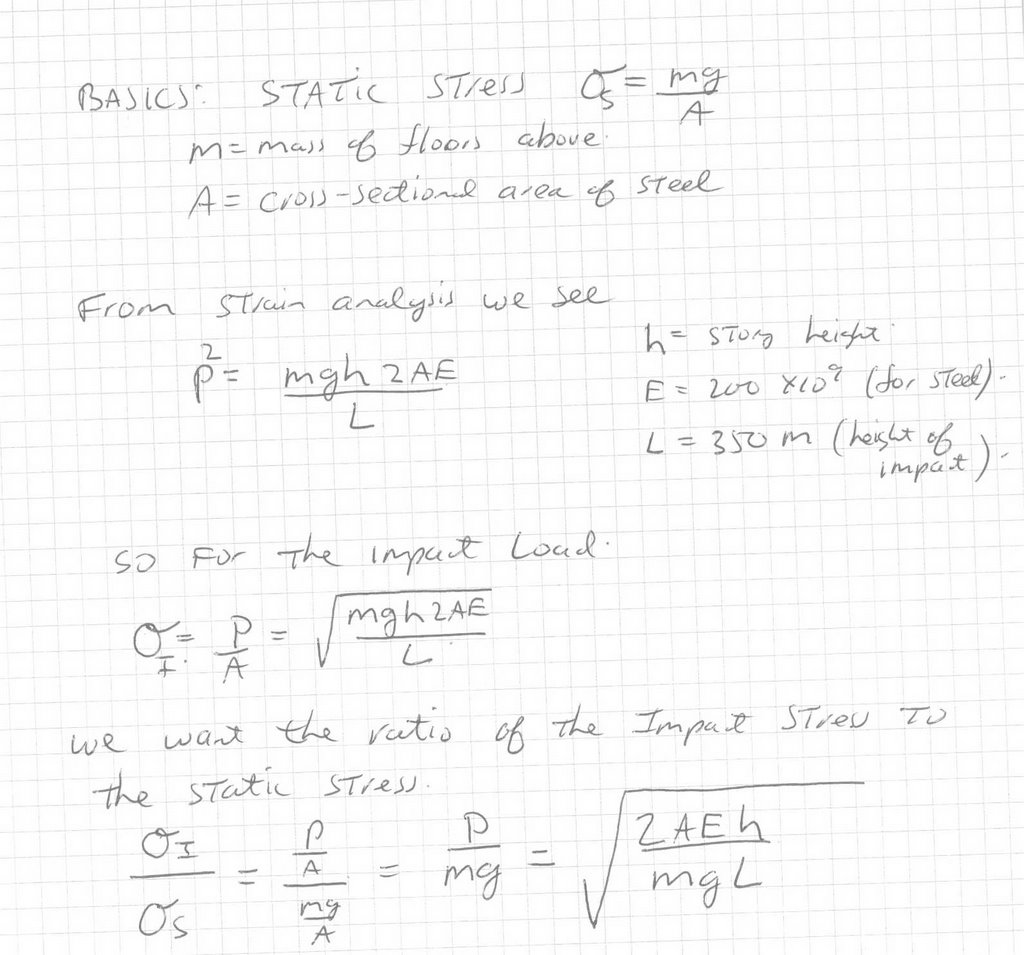

Some assumptions that are implicit to the analysis that I did and the effects of those assumptions are as follow:
- The analysis assumes that there is no material deformation of the structure. At first glance this would appear to be enough to cause my method to be invalid (after all there is a fair amount of material deformation), but I thought about it and if material deformation does take place then the analysis is invalid but the structure has already started to fail so I don't think it is that much of a restriction.
- The analysis assumes that the impact will be evenly distributed over the surface which it probably will not be. This would act to increase the dynamic stress.
- The analysis ignores the elastic compression in the tower. Since the height was so large this would probably be significant. By ignoring it the analysis that I have done here is conservative.
- I assumed that the steel structure was the same above the impact as it was at the impact. This is probably not the case (the supports were tapered) and again this would make our estimate conservative.
- I have also ignored the deformation and heat problems due to the jet striking the building. This would be very significant in the first floor or two but would be less significant as we go further down in the building.
- I should also note that after the first floor or two my analysis again goes out the window. First, you no longer have a solid (or even semi solid) object causing the impact but something like a wave of rubble. Also, as each floor falls you start to pick up kinetic energy. If the floor fails then it did not absorb all the potential energy. This leftover energy will be in the form of kinetic and at the next level you get potential and kinetic. I ignored the kinetic. What the net result of these two factors would be I haven't a clue, but I suspect that the kinetic energy would be such that it would eventually dominate the equation. Thus my analysis could show how it would start and then it is driven by the extra kinetic energy picked up as each floor collapsed.
As I said in my previous e-mail I guessed at a lot of values and came up with a crude estimate of 40 times the static load (actually it was 36). While this is a far cry from my initial guess of 2,000 (what is a factor of 50 between friends) It is still very significant.
However I wanted a better estimate and thus I went into it a little more this morning and it turns out that a lot of my assumptions (i.e. the area of steel, the height of each floor) don't matter. The important assumption is how much each floor weighs and I assumed that it was 1.5 times the weight of the steel. For the weight of the steel I used the density of steel x area of steel x height of the floor. If you don't like my 1.5 factor you can easily replace it with one of your own.
I find it hard to talk about math in an e-mail so I am attaching some scans of my work. If this is going to be put on the net you should probably go over it fairly well to check my assumptions, my equation manipulation and calculations (Editorial note: John is giving me way too much credit). My final answer is 32. Thus the dynamic load is 32 times the static load. I don't know about the WTC but for most structures a safety factor of 2 or 4 is used. I heard Dr. Thomas Eagar give a guess of a safety factor of 5. So my analysis is still 6 times this!!!
I will note that I am a mechanical engineer, not a civil one and someone with an advanced degree in structural mechanics could probably pick some holes in my analysis, but with the stipulations above I believe it is pretty sound.
John
PS I will probably be sending you e-mails with little comments on them as I think of things. For example I ignored the structural aspects of the building. For example there are areas on the floor that are designed to take only the load of the floor so even a static load of 10 times the expected load would cause failure - let alone the dynamic load!!!
-----------
John's second email:
Hi Brian:
I was going over my calculations trying to get better estimates and I realized a couple of things.
1) My h is too small (I used 3 meters but a better guess would probably be 3.7.
2) I underestimated my floor weight. I have a couple of references that say that each floor was about 4,500 t. I have no idea how they come up with this figure - it seems too high to me but the people who give it probably know more than me.
Anyway, I was looking for references and I came across this one. You have probably already read it but I found it interesting:
http://www.tam.uiuc.edu/news/200109wtc/
They used a similar approach to what I did (except they seem to have rolled up E, A and L into a single constant - probably a good idea which would save you integrating but I didn't have all the information to allow me to do it). However what I found interesting was their first estimate was a ration of dynamic load to static load of 31!!! So I think my rough value of 31.5 is actually pretty good (even though I have errors in my analysis it would appear that my errors cancelled out). In engineering sometimes it pays to be lucky instead of smart!!
Best,
John
Sunday, April 23, 2006
The Gronholm Method
In high school I had the oh-so-deep realization that artists took pop cultural fluff and turned it into high art. In my case it stemmed from seeing Norman Mailer transform your standard pulp war fiction into The Naked and The Dead, although it should have been obvious to me a lot earlier, say with Shakespeare.
Anyway, it's been done again with The Gronholm Method ("El Metodo"). This movie takes the Apprentice/Survivor concept from pop entertainment to art - an extremely well done depiction of people united in being pit against each other. It was striking to see this movie just shortly after watching "Crash" on DVD - Crash is okay, but this is a lot better. See it if you get the chance.
(For some reason, it also reminds me of a similar film for paranoid sci-fi fans, Cube.)
Anyway, it's been done again with The Gronholm Method ("El Metodo"). This movie takes the Apprentice/Survivor concept from pop entertainment to art - an extremely well done depiction of people united in being pit against each other. It was striking to see this movie just shortly after watching "Crash" on DVD - Crash is okay, but this is a lot better. See it if you get the chance.
(For some reason, it also reminds me of a similar film for paranoid sci-fi fans, Cube.)
Friday, April 21, 2006
A partisan attack on Sierra Club, from the left
Sierra Club is picking up all kinds of flack for endorsing Republican Senator Lincoln Chafee. Chafee's had a few bad votes, like every other politician, but overall has been a good environmentalist.
Firedoglake, Kos, and Atrios have all been after Sierra Club, but to the extent they criticize SC for supporting someone who voted in Bill Frist as Senate Majority Leader, they're attacking it for not being a wholly-owned subsidiary of the Democratic party, which is a ridiculous basis for the attack. (Might also be worth remembering that Frist's Republican competitors for his job were even worse than him.)
Two other points worth mentioning: while Sierra Club is non-partisan, it's no secret that its membership and likely its leadership skews somewhat to the left. When SC endorses a Republican, they're overcoming a bias, so the accusations flung against them ring hollow. Second, if you read this comment thread, it's pretty clear that the people who actually know something about Chafee are much more sympathetic to the endorsement than the fire-breathers. More evidence suggesting the fire-breathers and the bloggers got it wrong.
Firedoglake, Kos, and Atrios have all been after Sierra Club, but to the extent they criticize SC for supporting someone who voted in Bill Frist as Senate Majority Leader, they're attacking it for not being a wholly-owned subsidiary of the Democratic party, which is a ridiculous basis for the attack. (Might also be worth remembering that Frist's Republican competitors for his job were even worse than him.)
Two other points worth mentioning: while Sierra Club is non-partisan, it's no secret that its membership and likely its leadership skews somewhat to the left. When SC endorses a Republican, they're overcoming a bias, so the accusations flung against them ring hollow. Second, if you read this comment thread, it's pretty clear that the people who actually know something about Chafee are much more sympathetic to the endorsement than the fire-breathers. More evidence suggesting the fire-breathers and the bloggers got it wrong.
Monday, April 17, 2006
Bush's second speech this August
For context, you might want to read the Bush's first speech on August 16th of this year.
Official White House Transcript
August 21, 2006
Speech by President Bush giving 48 hours to Iranian dictator Ahmadinejad to step down and end radiological threats from Iran
Good evening.
When I spoke to you last, five days ago, I announced that American forces had taken the decisive step to end the nuclear bomb threat from Iran. Our forces successfully destroyed the machinery that we know to be designed for nuclear weapons, not nuclear power. To save American lives and Iranian lives too, American forces used a fission-enhanced penetration weapon to destroy the Natanz gas centrifuge. Fission-enhanced penetration should not be considered nuclear bombing, as has been made quite clear.
Our necessary action made the mistake of the Iranian dictator equally clear. "President" Ahmadinejad brought this situation on his country by his dangerous pursuit of a new Holocaust, a nuclear Holocaust. We stopped him. History will be clear - we did the right thing.
Yesterday, President Ahmadinejad compounded his mistake. The crowds he spoke to in Tehran were brought there using a combination of force, hysteria, and lies. Whatever misleading images have been shown by the media, the Iranian people as a whole know that we want to help them, they love freedom, and they oppose their dictator.
Just a small, fanatical few support the dictator mullahs, but these few people control all the power. Fanning the hysteria, maybe even believing it himself, Ahmadinejad accuses us of attacking them with nuclear bombs. That is a lie. We did not use nuclear bombs; we used one fission-enhanced weapon. We did not start this confrontation; as stated before, our evidence leaves no doubt that Iran planned to distribute nuclear bombs to terrorists. Self-defense is not an attack.
Ahmadinejad then took a fatal step - he said in retaliation for raining "nuclear fire" on his own people, Iran will "soon" explode a radiological bomb at an American government or military facility within a major US city. The "nuclear fire" is a lie; we did not use a nuclear bomb, and all the military facilities that we hit were carefully targeted to minimize civilian casualties. Iran's dictators have no right to retaliate against something we had to do in self-defense.
While we have eliminated the greatest threat, Iranian nuclear bombs, a severe threat has now arisen from this planned "dirty bomb" attack. We have to take direct action to counter this new threat. To those who disagreed with our decision for pre-emptive self-defense in Iran, the need for self-defense should now be clear. Hindsight is not wisdom, but foresight about an open threat to our cities is simply obvious. We must remove Ahmadinejad and eliminate the threat he poses.
President Ahmadinejad has 48 hours to resign. A man this dangerous can no longer rule the country. Iran's subsequent leader must, in the same time period, renounce any plan to subject the United States to radiological attack, and open all nuclear facilities to UN inspection and inventory. If this deadline is missed, Operation Persian Freedom will begin.
We have made it clear to the Iranian people that our problem is not with them, but with the dictators who stole their country. Their freedom and sovereignty will be returned to them from the dictator mullahs who robbed them.
This dangerous world requires both courage and hope. I know our brave American soldiers have both courage and hope; I know the brave American people do as well. Moving forward today, we save Iran and save our own country.
May God bless America's work, and may God bless us all.
Official White House Transcript
August 21, 2006
Speech by President Bush giving 48 hours to Iranian dictator Ahmadinejad to step down and end radiological threats from Iran
Good evening.
When I spoke to you last, five days ago, I announced that American forces had taken the decisive step to end the nuclear bomb threat from Iran. Our forces successfully destroyed the machinery that we know to be designed for nuclear weapons, not nuclear power. To save American lives and Iranian lives too, American forces used a fission-enhanced penetration weapon to destroy the Natanz gas centrifuge. Fission-enhanced penetration should not be considered nuclear bombing, as has been made quite clear.
Our necessary action made the mistake of the Iranian dictator equally clear. "President" Ahmadinejad brought this situation on his country by his dangerous pursuit of a new Holocaust, a nuclear Holocaust. We stopped him. History will be clear - we did the right thing.
Yesterday, President Ahmadinejad compounded his mistake. The crowds he spoke to in Tehran were brought there using a combination of force, hysteria, and lies. Whatever misleading images have been shown by the media, the Iranian people as a whole know that we want to help them, they love freedom, and they oppose their dictator.
Just a small, fanatical few support the dictator mullahs, but these few people control all the power. Fanning the hysteria, maybe even believing it himself, Ahmadinejad accuses us of attacking them with nuclear bombs. That is a lie. We did not use nuclear bombs; we used one fission-enhanced weapon. We did not start this confrontation; as stated before, our evidence leaves no doubt that Iran planned to distribute nuclear bombs to terrorists. Self-defense is not an attack.
Ahmadinejad then took a fatal step - he said in retaliation for raining "nuclear fire" on his own people, Iran will "soon" explode a radiological bomb at an American government or military facility within a major US city. The "nuclear fire" is a lie; we did not use a nuclear bomb, and all the military facilities that we hit were carefully targeted to minimize civilian casualties. Iran's dictators have no right to retaliate against something we had to do in self-defense.
While we have eliminated the greatest threat, Iranian nuclear bombs, a severe threat has now arisen from this planned "dirty bomb" attack. We have to take direct action to counter this new threat. To those who disagreed with our decision for pre-emptive self-defense in Iran, the need for self-defense should now be clear. Hindsight is not wisdom, but foresight about an open threat to our cities is simply obvious. We must remove Ahmadinejad and eliminate the threat he poses.
President Ahmadinejad has 48 hours to resign. A man this dangerous can no longer rule the country. Iran's subsequent leader must, in the same time period, renounce any plan to subject the United States to radiological attack, and open all nuclear facilities to UN inspection and inventory. If this deadline is missed, Operation Persian Freedom will begin.
We have made it clear to the Iranian people that our problem is not with them, but with the dictators who stole their country. Their freedom and sovereignty will be returned to them from the dictator mullahs who robbed them.
This dangerous world requires both courage and hope. I know our brave American soldiers have both courage and hope; I know the brave American people do as well. Moving forward today, we save Iran and save our own country.
May God bless America's work, and may God bless us all.
Tuesday, April 11, 2006
How they'll spin it, coming this August
My crystal ball showed me this speech by President Bush this upcoming August. More information on the factual background is here.
Be prepared.
Official White House Transcript
August 16, 2006
Speech by President Bush authorizing use of fission-enhanced penetration weapon to end Iran's nuclear bomb-making
Good evening.
Earlier today, I took the step that we have delayed as long as humanly possible, and authorized military action to end Iran's dangerous and illegal nuclear bomb-making program. Our brave fighting men and women have begun military operations, and all reports show that we have been successful in our efforts.
The dictator mullahs of Iran have denied they are creating nuclear bombs, but their lies can no longer be tolerated or excused. We simply cannot wait any longer. Every day that they continue purifying weapons-grade uranium brings us closer to the day when a terrorist nuclear bomb will explode in America, in Israel, and elsewhere in the West, causing countless civilian casualties. And these faceless terrorists would have not one nuclear bomb, but dozen or more, giving small groups of heartless fanatics the capacity to wage a world war. We have to stop them.
This danger to the world is not a risk, it is a certainty. The documentary evidence that the Secretary of State will present to the UN Security Council tomorrow will prove that Iranian mullahs planned to develop and distribute nuclear bombs to terrorists. We had to act, and we had to act now.
Iran's dictatorial leaders, together with some sincere-but-misguided Americans, accuse us of planning this operation for months. While we have to make advance plans, we never wanted to go forward with it. The Iranian dictators left the world without a choice.
The dictators and their misguided supporters here also accused us of planning to use nuclear bombs against Iran. Now we all have seen pictures of the devastation caused by gigantic nuclear bombs, both in tests and in the horrible, and necessary, bombing of Hiroshima that ended the Second World War. This is unthinkable - we would not use nuclear bombs such as these, and we have not done so.
The term "nuclear bomb" should appropriately belong to these massive, city-destroying weapons. To stop Iran's effort to make many such nuclear bombs, we have used something else. Typical convential weapons cannot reach the heart of Iran's weaponry program, the uranium gas centrifuges of Natanz, buried under seventy-five feet of shielding. If we were to shut down Iran's program with typical weaponry, we would have had to attack hundreds of "softer" targets, where the mullahs have made human shield hostages of their civiliam population. Or we would have had to launch risky ground operations in Natanze, causing the unnecessary deaths of American servicemen and women. Others may support the unnecessary death of American warriors defending our country, but I cannot.
The fission-enhanced penetration weapon that earlier today, breached and destroyed the Natanz nuclear bomb program, should not be considered a nuclear bomb itself. It is a destroyer of nuclear bombs and a saver of human life. The enhanced weapon does not have the destructive size or destructive intent of real nuclear bombs, and belongs in a separate class for military operations. The weapon, modified to maximize bunker-busting with very little radiation, was a success. We believe that any radiation now escaping from Natanz is from the destroyed uranium centrifuge operation, and the mullahs can only blame themselves for that problem.
With the Natanz operation destroyed, we have had to attack far fewer targets elsewhere in Iran. We believe that few if any civilians were harmed.
While it is unfortunate that we had to take this step, America and the world is better off for us having done so.
There is little chance that the Iranian dictatorship will learn from this mistake, but we know the Iranian people will see how the mullahs betrayed them and forced this attack. We extend our hand in friendship to the Iranian people, and we will gladly help them in their legitimate wish to be free.
We are all safer now, thanks to the bravery of our men and women in uniform. Our prayers are with them as they return, and we know all good-thinking people will support our troops in their own prayers.
May all our efforts for peace be rewarded, and may God bless America.
Be prepared.
Official White House Transcript
August 16, 2006
Speech by President Bush authorizing use of fission-enhanced penetration weapon to end Iran's nuclear bomb-making
Good evening.
Earlier today, I took the step that we have delayed as long as humanly possible, and authorized military action to end Iran's dangerous and illegal nuclear bomb-making program. Our brave fighting men and women have begun military operations, and all reports show that we have been successful in our efforts.
The dictator mullahs of Iran have denied they are creating nuclear bombs, but their lies can no longer be tolerated or excused. We simply cannot wait any longer. Every day that they continue purifying weapons-grade uranium brings us closer to the day when a terrorist nuclear bomb will explode in America, in Israel, and elsewhere in the West, causing countless civilian casualties. And these faceless terrorists would have not one nuclear bomb, but dozen or more, giving small groups of heartless fanatics the capacity to wage a world war. We have to stop them.
This danger to the world is not a risk, it is a certainty. The documentary evidence that the Secretary of State will present to the UN Security Council tomorrow will prove that Iranian mullahs planned to develop and distribute nuclear bombs to terrorists. We had to act, and we had to act now.
Iran's dictatorial leaders, together with some sincere-but-misguided Americans, accuse us of planning this operation for months. While we have to make advance plans, we never wanted to go forward with it. The Iranian dictators left the world without a choice.
The dictators and their misguided supporters here also accused us of planning to use nuclear bombs against Iran. Now we all have seen pictures of the devastation caused by gigantic nuclear bombs, both in tests and in the horrible, and necessary, bombing of Hiroshima that ended the Second World War. This is unthinkable - we would not use nuclear bombs such as these, and we have not done so.
The term "nuclear bomb" should appropriately belong to these massive, city-destroying weapons. To stop Iran's effort to make many such nuclear bombs, we have used something else. Typical convential weapons cannot reach the heart of Iran's weaponry program, the uranium gas centrifuges of Natanz, buried under seventy-five feet of shielding. If we were to shut down Iran's program with typical weaponry, we would have had to attack hundreds of "softer" targets, where the mullahs have made human shield hostages of their civiliam population. Or we would have had to launch risky ground operations in Natanze, causing the unnecessary deaths of American servicemen and women. Others may support the unnecessary death of American warriors defending our country, but I cannot.
The fission-enhanced penetration weapon that earlier today, breached and destroyed the Natanz nuclear bomb program, should not be considered a nuclear bomb itself. It is a destroyer of nuclear bombs and a saver of human life. The enhanced weapon does not have the destructive size or destructive intent of real nuclear bombs, and belongs in a separate class for military operations. The weapon, modified to maximize bunker-busting with very little radiation, was a success. We believe that any radiation now escaping from Natanz is from the destroyed uranium centrifuge operation, and the mullahs can only blame themselves for that problem.
With the Natanz operation destroyed, we have had to attack far fewer targets elsewhere in Iran. We believe that few if any civilians were harmed.
While it is unfortunate that we had to take this step, America and the world is better off for us having done so.
There is little chance that the Iranian dictatorship will learn from this mistake, but we know the Iranian people will see how the mullahs betrayed them and forced this attack. We extend our hand in friendship to the Iranian people, and we will gladly help them in their legitimate wish to be free.
We are all safer now, thanks to the bravery of our men and women in uniform. Our prayers are with them as they return, and we know all good-thinking people will support our troops in their own prayers.
May all our efforts for peace be rewarded, and may God bless America.
Bob Carter won't bet over global warming
Following Tim Lambert's post on Bob Carter, I emailed Professor Carter to see if he would bet me over global warming, offering 2:1 odds that temperatures will increase in 10 years.
He politely emailed me back, saying that because temperature change is a random walk, he won't bet me. I've replied to say that doesn't make sense.
Either he doesn't believe temperature changes are random, or he should bet me.
He politely emailed me back, saying that because temperature change is a random walk, he won't bet me. I've replied to say that doesn't make sense.
Either he doesn't believe temperature changes are random, or he should bet me.
Monday, April 10, 2006
Adjusting Kyoto requirements for low-population-density nations
I'm too cheap to pay and read the whole article, but New Scientist is highlighting proposals to adjust carbon emission requirements from countries with low population densities:
I welcome the concept of introducing equity and fairness into the Kyoto targets, but I think my idea of allocating per-capita emissions worldwide would accomplish the same purpose. The per-capita emissions, allocated worldwide and then aggregated for each nation, should be net emissions, so low-density countries will have the opportunity to use their forests etc. as a sink to reduce their emissions. Reduce emissions enough, and then the low density nation can sell part of its emission quota to other nations.
The presence of carbon sinks in low-density nations is/should be a double-edged sword, though. If a nation screws with its carbon sink, say by cutting down the trees, then it has added to the net emissions from the country. That should be part of the climate management picture.
Their rationale is that large countries have more natural vegetation to absorb pollution, and more fields and forests to provide natural resources for the world. So they should be entitled to a larger ecological footprint than small, densely populated countries.
I welcome the concept of introducing equity and fairness into the Kyoto targets, but I think my idea of allocating per-capita emissions worldwide would accomplish the same purpose. The per-capita emissions, allocated worldwide and then aggregated for each nation, should be net emissions, so low-density countries will have the opportunity to use their forests etc. as a sink to reduce their emissions. Reduce emissions enough, and then the low density nation can sell part of its emission quota to other nations.
The presence of carbon sinks in low-density nations is/should be a double-edged sword, though. If a nation screws with its carbon sink, say by cutting down the trees, then it has added to the net emissions from the country. That should be part of the climate management picture.
Subscribe to:
Posts (Atom)